- Location
- Puerto Rico
- Current protection
- El Yunque National Forest and El Toro Wilderness (U.S. Forest Service), a UNESCO Biosphere Reserve
- Status
- No active campaign
- In the book
- Not featured in Undiscovered America
Why should it be a National Park?
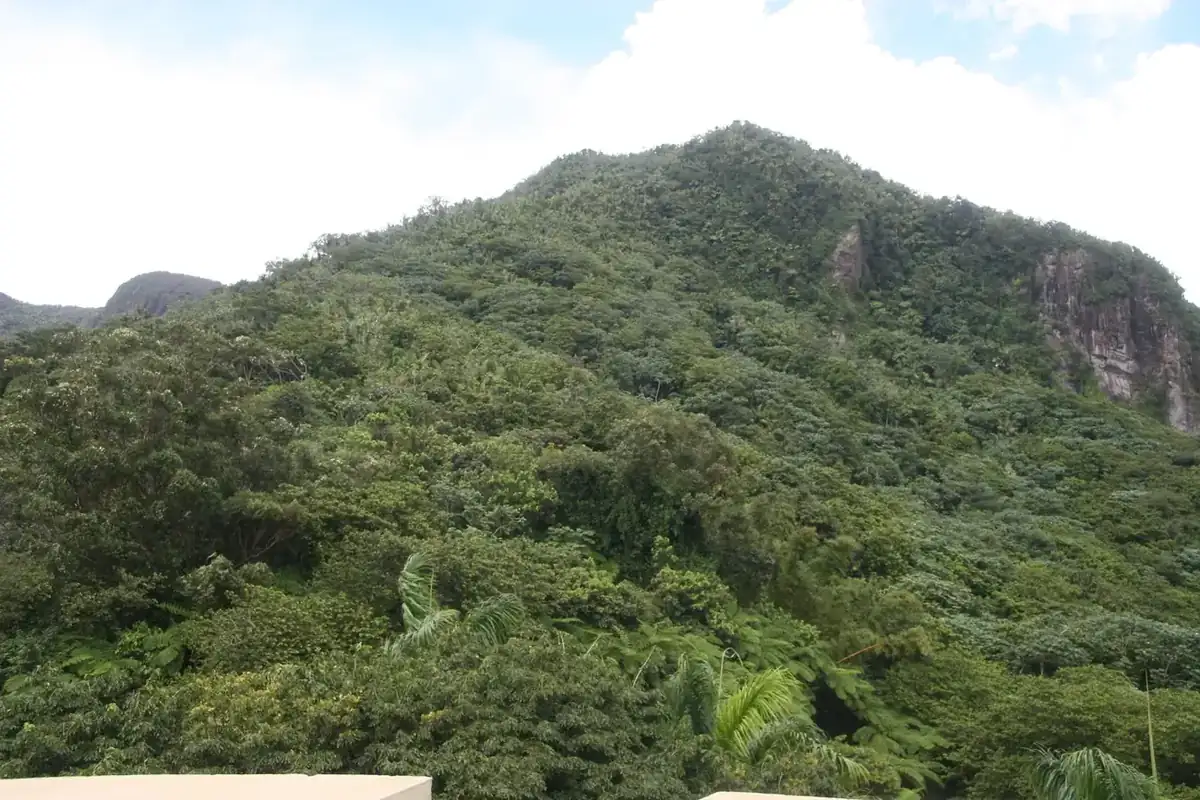
El Yunque is the only tropical rainforest the federal government owns, and the whole of it would fit inside the parking lots of some western parks. Twenty-eight thousand acres on the Luquillo Mountains catch as much as twenty feet of rain a year, which is enough water to build four distinct forests stacked on top of each other, ending in a wind-flattened dwarf forest of mossy, knee-high trees on the summits.
It is loud in a way no mainland forest is. The coquí, a frog the size of a thumbnail, sings all night in numbers that turn the hillsides into one continuous sound. Above it flies the Puerto Rican parrot, which fell to thirteen birds in the wild in 1975 and survives now only because of work done inside this forest. Neither species lives anywhere else on earth.
The forest has been protected longer than almost anything else in the Americas. The Spanish Crown set it aside in 1876, twenty-two years before the United States arrived, and Theodore Roosevelt proclaimed it a federal reserve in 1903. That century and a half of protection is the reason there is still an old-growth tropical forest here at all, on an island that cleared nearly everything else for sugar and coffee.
The case is straightforward. No unit of the National Park System protects a tropical rainforest, this one sits a short drive from a city of two million and an international airport, and Puerto Rico, with more people than twenty states, has no National Park at all. The obstacle is interagency rather than substantive: the forest is already federal, and the Forest Service has never been eager to give up the only tropical rainforest it holds.
The forest is also a laboratory with a long memory. Researchers have been measuring the same plots at Luquillo for decades, through Hurricane Hugo in 1989 and Maria in 2017, which makes this one of the best-documented tropical forests anywhere for what a rainforest does after it is flattened. The answer, roughly, is that it comes back fast and different.
Access is the problem a park designation would have to fund its way out of. One road, PR-191, carries nearly everyone who comes, and it dead-ends where a landslide closed it decades ago. The Forest Service already runs reservations for the busiest section on a forest budget. Park designations move money, and reopening the road across the mountain is the kind of project that follows the title rather than precedes it.
There is also a question of what Puerto Rico gets. The island has no National Park, and the units it does have are historical, San Juan's fortifications above all. For three million American citizens, the nearest National Park is a flight away. That is the strongest argument anyone makes here, and it is not a geological one.
The history of National Park Campaigns
El Yunque is the oldest protected forest under the American flag, and the fights over it have been about wilderness and names rather than park status. No bill to make it a National Park appears in the record, which makes it one of the few places on this list whose park proposal has never had a sponsor.
- Distinct National Park attempts
- none on record.
- Other designation attempts
- 2 (biosphere reserve 1976; wilderness 2005).
Sources
- U.S. Forest Service, El Yunque National Forest: history and land management pages
- Caribbean National Forest Wilderness Act of 2005
- UNESCO Man and the Biosphere Programme, Luquillo Biosphere Reserve
- U.S. Fish and Wildlife Service, Puerto Rican Parrot Recovery Program
- 1876
The Spanish Crown sets aside the Luquillo forest, one of the first forest reserves in the Western Hemisphere.
- January 17, 1903
President Theodore Roosevelt proclaims the Luquillo Forest Reserve, five years after the United States takes Puerto Rico.
- 1930s
The reserve is renamed the Caribbean National Forest. The Civilian Conservation Corps builds the roads, trails, and recreation areas still in use.
- 1976
UNESCO names the forest a Biosphere Reserve.
- December 2005
Congress designates the El Toro Wilderness, roughly 10,000 acres, the first tropical wilderness in the National Wilderness Preservation System.
- 2007
The Caribbean National Forest is renamed El Yunque National Forest, restoring the name islanders had always used.
- September 20, 2017
Hurricane Maria strips the canopy and destroys much of the trail and road system. The forest closes, and recovery runs for years.
- To date
No bill has been introduced to make El Yunque a National Park.