- Location
- Pennsylvania
- Current protection
- Ricketts Glen State Park, World's End State Park, Pine Creek Gorge
- Status
- No active campaign
- In the book
- Featured in Undiscovered America
Why should it be a National Park?
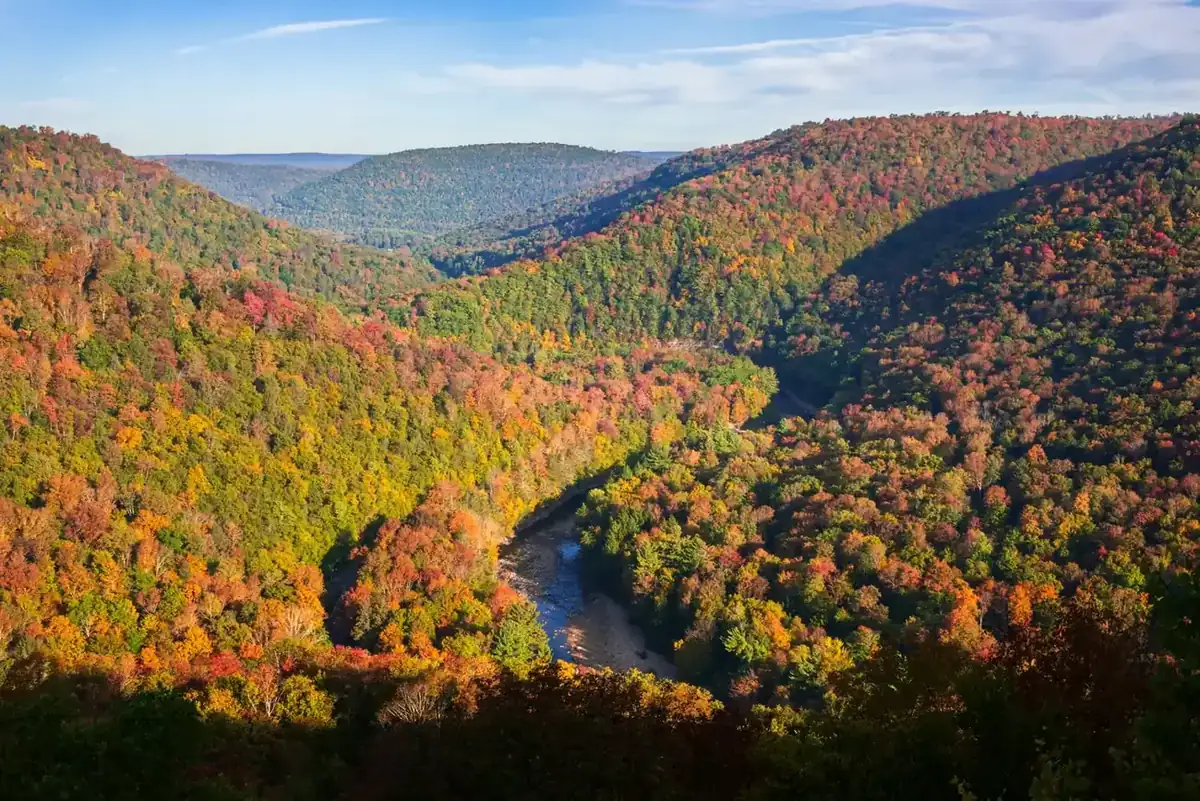
The Endless Mountains are a region in northern Pennsylvania made up of hills, canyons, and rivers that rise and plunge across hundreds of miles of forested wilderness. The most commonly visited sites in the region are Ricketts Glen and World's End State Parks, as well as the complex of state lands that comprise the boundaries of the massive Pine Creek Gorge.
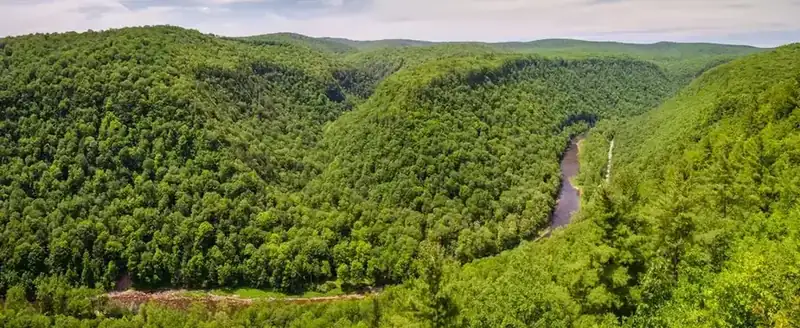
Pine Creek Gorge lies at the western portion of the Endless Mountains region. This 1,450 feet deep river canyon carved its way into the woods of Pennsylvania and carries the nickname "The Grand Canyon of the East". It extends 47 miles through rugged terrain, offering scenic viewpoints and trails. The best known ways to access the gorge are from Leonard Harrison and Colton Point State Parks that flank the edges of the canyon at its most expansive point. Additional state forests overlay the majority of the gorges length, providing several impressive, but harder to reach overlooks. In addition to hiking trails and roads, 65 miles of former railways routes have been converted to rail trails for biking. This experience is unique among major gorges and easily allows visitors to experience the full depth of the gorge by being totally enveloped by it.
Venturing deeper, you can visit the impressive scenery of World's End State Park, which showcases tremendous views of forested hills and the winding Loyalsock Creek valley between them. These hills and the rivers that split them are not connected to Pine Creek Gorge and offer a different landscape within the Pennsylvania wilds. The rocky terrain found at World's End features large boulders and rock formations on the hillsides and within the creek itself. The park's central focus isn't the substantial scenery, however, but outdoor recreation. Here you can throw yourself into the activities that define the region; fishing, hiking, camping, whitewater kayaking, swimming, picnicking, and even seasonal hunting on roughly half of the park's land.
Traveling further east, you'll find Ricketts Glen, the crown jewel of the Endless Mountains. It is a wonderland of waterfalls and lush greenery that was originally slated to join the National Park Service in the 1930s, before the plans were set aside due to lack of funds during the Great Depression. It is currently administered as a Pennsylvania state park, but this park is the centerpiece for redefining the grandeur of forgotten nature in the Northeastern United States. Ricketts Glen covers just over 13,000 acres, boasting 24 major waterfalls which are accessible via a single trail that follows the path of Kitchen Creek as it descends through a series of glens.
The Endless Mountains region has an extensive history as a geological oddity and as home to various Native American tribes before colonization pushed them aside. As settlers replaced the displaced tribes, the area became a small tourist attraction. Over the years, ease of travel and the prevalence of cities on the east coast resulted in the area being somewhat overlooked or forgotten.
While Ricketts Glen was intended to become a National Park Service site in the 1930s, World War II brought an end to this plan for development and it instead became a Pennsylvania state park.
The history of National Park Campaigns
Pennsylvania's own park history says Ricketts Glen "was approved as a National Park site in the 1930s." The fuller record: in 1935 a 22,000-acre area was approved and the National Park Service opened a CCC camp there, but in 1936 the money was "sidetracked" to the Resettlement Administration for direct relief — the same fate that befell Pennsylvania's five Recreational Demonstration Areas (French Creek, Raccoon Creek, Laurel Hill, Blue Knob, Hickory Run), which strongly suggests Ricketts Glen was slated as a federal recreation area in the RDA family rather than a "National Park" in the Yellowstone sense. Depression finances and WWII ended it; the state bought the glens in 1942.
- Distinct National Park attempts
- 1 (1935 federal approval, defunded 1936)
- Other designation attempts
- state park 1941–44; NNL 1969; Natural Area 1993
Sources
- PA DCNR, "History of Ricketts Glen State Park"
- John C. Paige, The CCC and the NPS, 1933–1942: An Administrative History (NPS, 1985), App. C
- NPS Recreational Demonstration Area program records (RG 79, NARA)
- Pennsylvania Department of Forests and Waters records on the 1941 act
- 1868–1918
Col. R. Bruce Ricketts assembles 80,000+ acres, logs most of it, spares ~2,000 acres of old growth in the glens, builds the Falls Trail (1889–93). (Wikipedia; DCNR)
- 1920–24
Heirs sell 48,000 acres to the Pennsylvania Game Commission, keeping 12,000+ acres around Ganoga Lake, Lake Jean, and the glens. (DCNR)
- 1935
FEDERAL PARK APPROVAL. "An area encompassing 22,000 acres was approved as a National Park site in 1935, and the National Park Service operated a Civilian Conservation Corps camp at 'Ricketts Glynn' (sic)." (Wikipedia-derived, citing John C. Paige, The Civilian Conservation Corps and the National Park Service, 1933–1942, App. C, Table C-1)
- 1936
Funding "sidetracked... when the money was redirected to the Resettlement Administration for 'direct relief.'" Parallel projects at French Creek, Raccoon Creek, Laurel Hill, Blue Knob, and Hickory Run were also defunded — all later NPS Recreational Demonstration Areas transferred to Pennsylvania in 1945. (same source; DCNR: "World War II brought an end to this plan for development")
- August 1, 1941
Governor signs the law creating Ricketts Glen State Park; 1942 — heirs sell 1,261 acres (falls and glens) to the Commonwealth; 1943, 1949 purchases from William Ricketts; 1944 park opens. (DCNR)
- October 12, 1969
Glens Natural Area designated a National Natural Landmark; 1993 State Park Natural Area.
Pine Creek Gorge — Leonard Harrison SP (1922), Colton Point SP (1936), NNL (1968), Pine Creek named a study river in the 1968 Wild & Scenic Rivers Act (VERIFY), Pine Creek Rail Trail (1996–2007). Worlds End SP (1932). No national-park proposal found for either.