- Location
- Louisiana
- Current protection
- Tensas River National Wildlife Refuge
- Status
- No active campaign
- Tier
- Tier 2 · National Monument
- In the book
- Not featured in Undiscovered America
Why should it be a National Park?
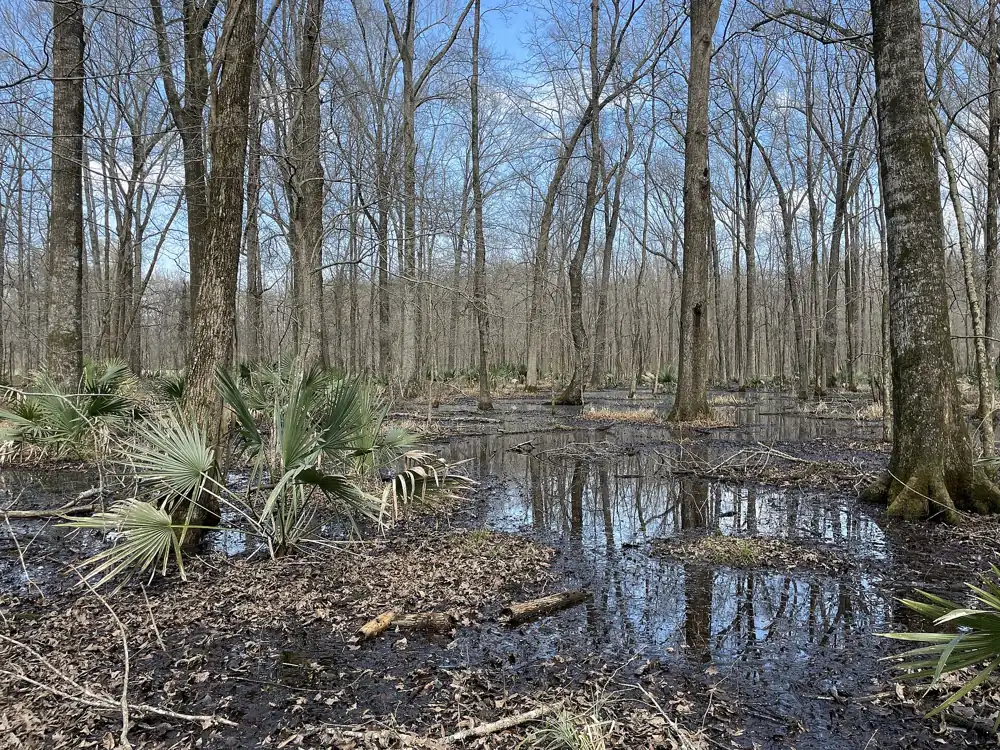
The Tensas River bottomlands of northeast Louisiana hold one of the largest remaining blocks of bottomland hardwood forest in the lower Mississippi Valley, oak and cypress swamp that once stretched for millions of acres. It is home to the Louisiana black bear, the animal that gave the teddy bear its name.
It was also the last place in America where the ivory-billed woodpecker was reliably seen, on the Singer Tract in the 1940s. The push to save that forest as a National Park failed, the forest was cut, and the bird vanished. The swamp that remains is the reason to try again.
The history of National Park Campaigns
In 1938, the National Audubon Society persuaded Sen. Allen Ellender to seek a National Park in the Tensas swamp, around the Singer Tract, the last known refuge of the ivory-billed woodpecker. It failed, and the tract was logged in the 1940s. Congress created Tensas River National Wildlife Refuge from what was left in 1980.
- Distinct National Park attempts
- 1 (1938)
- Other designation attempts
- 1 (1980 national wildlife refuge)
Sources
- "The Resurrection of the Lord God Bird," Wisconsin Academy of Sciences, Arts, and Letters (2015)
- Wikipedia, List of proposed National Parks of the United States
- 1935
Cornell ornithologists film and record ivory-billed woodpeckers on the Singer Tract.
- 1938
The Audubon Society persuades Sen. Allen Ellender to seek a National Park in the Tensas swamp.
- 1944
The last widely accepted sighting of an ivory-bill on the Singer Tract, as logging clears the forest.
- 1980
Congress establishes Tensas River National Wildlife Refuge.