- Location
- New York
- Current protection
- Adirondack Park / NYS Forest Preserve, Whiteface Mountain, Lake Placid Olympic sites
- Status
- No active campaign
- In the book
- Featured in Undiscovered America
Why should it be a National Park?
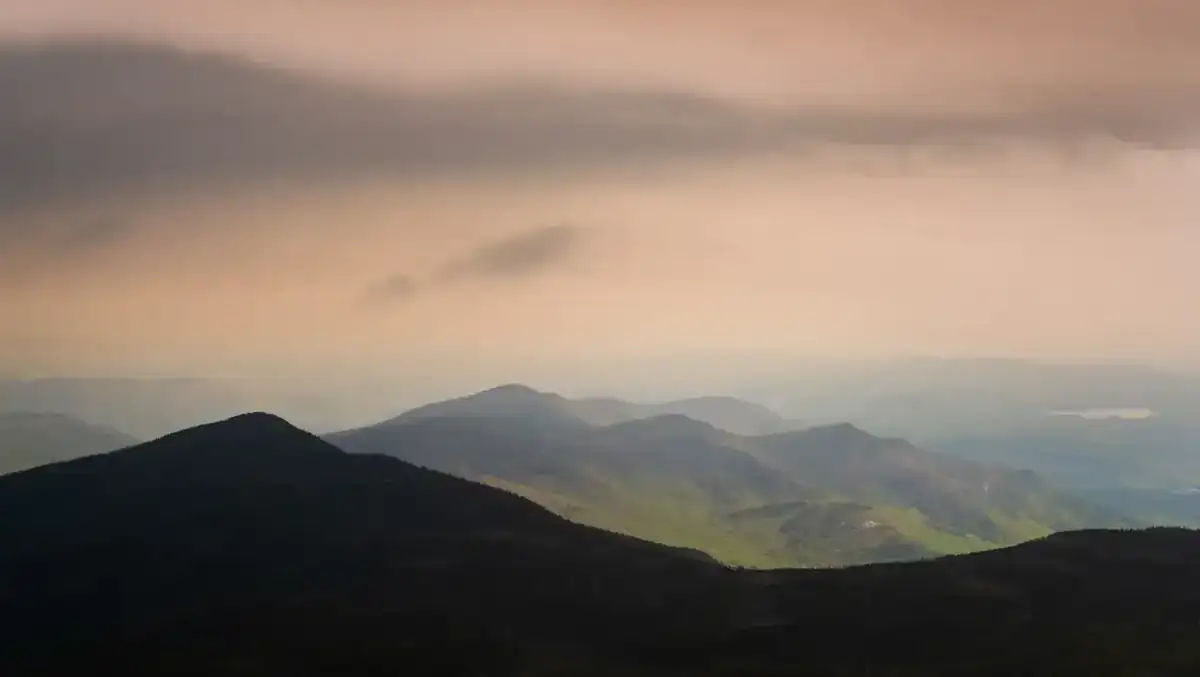
The Adirondack Mountains encompass nearly all of northeastern New York State, between Albany and the borders of Vermont and Canada. Roughly six-million-acres of this region are currently managed as Adirondack Park, a state park larger than any National Park in the lower 48 states. Even with its prominent name, vast scale, and the 7-10 million visitors it receives a year, few people outside of the northeast even know what the Adirondacks look like.
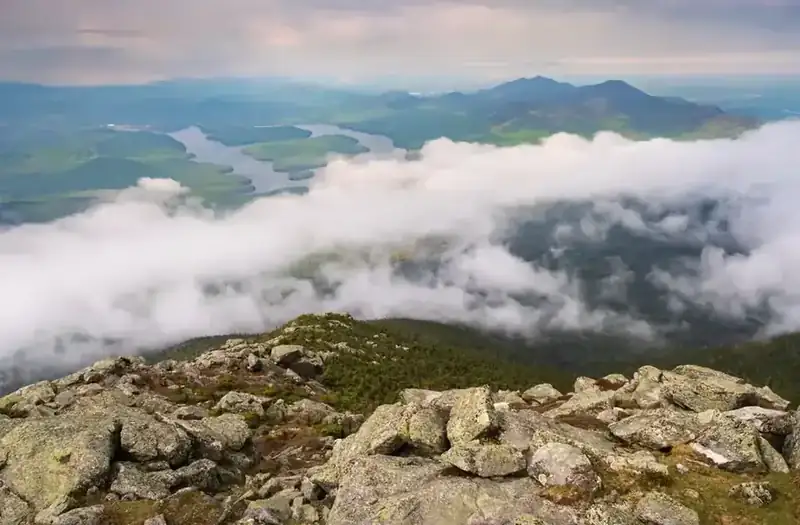
The mountains rise like a plateau from the forested lowlands that surround them. While the mountain range was once much higher repeated glaciation, the process of being covered and uncovered by ice sheets during ice ages, flattened the once prominent peaks into domes of striated rock. The ice dug out surrounding valleys and waterways and created over 30,000 miles of rivers and streams, and thousands of lakes. These waters allowed lush wetlands and old-growth forests to prosper, giving life to large and diverse animal populations.
In 1885, New York state recognized the unique character of the Adirondacks and set aside the region as a state park. Ever since, it has been managed as part of the New York State Forest Preserve, which also protects parts of the Catskill Mountains. In 1894, the New York State Constitution added, Article VII, Section 7, which reads in part: "The lands of the state, now owned or hereafter acquired, constituting the forest preserve as now fixed by law, shall be forever kept as wild forest lands. They shall not be leased, sold or exchanged, or be taken by any corporation, public or private, nor shall the timber thereon be sold, removed or destroyed."
Prior to this constitutional amendment, the Adirondacks had been open to logging. Fortunately, in the 20th Century, the conservation movement drove people to protect their local natural wonders and these logging practices were largely halted. However, unlike National Parks this state system allowed the local population to stay and play an active role in the park contributing to its uniqueness. Over half the park is privately owned, with 130,000 year-round residents and over a hundred villages, while the rest of the park is managed as wilderness. These towns survive on the seasonal tourism this mountain wilderness provides.
Despite Adirondack Park being widely accepted as a well-run preserve, several attempts have been made to establish an Adirondack National Park, including a popular, but ultimately unsuccessful campaign from 1967. In the years following this attempt, the borders of Adirondack Park have continued to grow, but the calls for elevating the park into a National Park have trailed off. While support for a National Park continues to be controversial, the scale and beauty of the mountains coupled with the lack of National Parks in this region, make it a compelling candidate.
There have been several attempts to create an "Adirondack Mountains National Park". This 1968 proposal was the closest, but fell short.
The history of National Park Campaigns
The Adirondacks were protected early and at the state level — the Adirondack Park (1892) and the "forever wild" clause (originally Article VII, now Article XIV, adopted 1894) — which made a later federal National Park legally and politically awkward, because federalization would have required extinguishing forever-wild protection on transferred lands. The single serious national-park proposal came in July 1967, when planners working for Laurance S. Rockefeller proposed a 1.72-million-acre Adirondack Mountains National Park in the central Adirondacks. It met near-universal local hostility, was rejected by Gov. Nelson Rockefeller, and instead catalyzed the Temporary Study Commission on the Future of the Adirondacks (1968–70) and the Adirondack Park Agency (1971). The idea has been revived only rhetorically since (notably a 2014 Almanack debate).
- Distinct National Park attempts
- 1 (1967)
- Other designation attempts
- ~2–3 (1892 state park establishment; 1971 APA regulatory regime; 2014 discussion — none federal)
Sources
- Brad Edmondson, A Wild Idea (2021)
- Frank Graham Jr., The Adirondack Park: A Political History (Knopf, 1978)
- "A Report on a Proposed Adirondack Mountains National Park" (1967, reprinted in Adirondack Daily Enterprise)
- Temporary Study Commission, "The Future of the Adirondack Park" (1970)
- Adirondack Experience / adkhistorycenter.org archives
- 1892 / 1894
(state baseline). New York created the Adirondack Park (1892) and adopted the "forever wild" constitutional clause (1894). Not a national-park attempt but the legal backdrop that made federal designation require a constitutional amendment. Source: adirondack.net "Forever Wild"; Wikipedia "Adirondack Park."
- July 1967
Adirondack Mountains National Park (federal, NP attempt #1). A study team assembled by Laurance S. Rockefeller (chair of the NYS Council of Parks) released "A Report on a Proposed Adirondack Mountains National Park," proposing ~1,720,000 acres: roughly 1,120,000 acres of existing state Forest Preserve plus ~600,000 acres of private land to be acquired, by condemnation if necessary. The story broke in the Saranac Lake Adirondack Daily Enterprise in late July 1967, which published the report in full. Rationale quote: "There is no wild area of scenic mountains, lakes, streams and forest of comparable quality and magnitude anywhere else in the eastern half of the United States." Sources: Adirondack Explorer ("Celebrating our parks," "A Wild Idea"); Adirondack Life ("Millionaire's Row"); adkhistorycenter.org.
- Sept.–Oct. 1967
local opposition. The Tupper Lake Village Board unanimously passed a resolution calling the proposal "detrimental to the interests of the people of the village of Tupper Lake and, in fact, to the interests of all the people in the Adirondacks." The Association for the Protection of the Adirondacks wired Gov. Rockefeller that New York was "already preserving this unique segment of our country... without placing it under the jurisdiction of the Federal government." The Adirondack Mountain Club (ADK) opposed it and lists 1967 among its centennial milestones: "ADK successfully opposes a proposal to create a National Park in Adirondacks, which would have removed 'forever wild' protection from about one-third of the Adirondack Park." Sources: adkhistorycenter.org; adk.org.
- Jan. 1968
rejection. Gov. Nelson Rockefeller declined to pursue the federal park.
- Sept. 18, 1968
Temporary Study Commission on the Future of the Adirondacks appointed (chaired by Harold K. Hochschild); its 1970 report "The Future of the Adirondack Park" made 181 recommendations, #1 being an Adirondack Park Agency. Hochschild: "If the Adirondacks are to be saved, time is of the essence." Source: Adirondack Explorer.
- 1971
Adirondack Park Agency created (private-land land-use control) — the lasting institutional legacy of the episode. Source: Adirondack Explorer; Edmondson, A Wild Idea.
- Nov. 2014
revival as debate. Adirondack Almanack essay ("What Would an Adirondack National Park Look Like?"), spurred by DEC forest ranger Scott van Laer, revisited the concept but concluded a park of Rockefeller's scope "would never be proposed again." Source: adirondackalmanack.com.