- Location
- Illinois/Missouri
- Current protection
- Cahokia Mounds State Historic Site (IL), Sugarloaf Mound (MO), Horseshoe Lake State Park
- Status
- Study bill in Congress
- In the book
- Not featured in Undiscovered America
Why should it be a National Park?
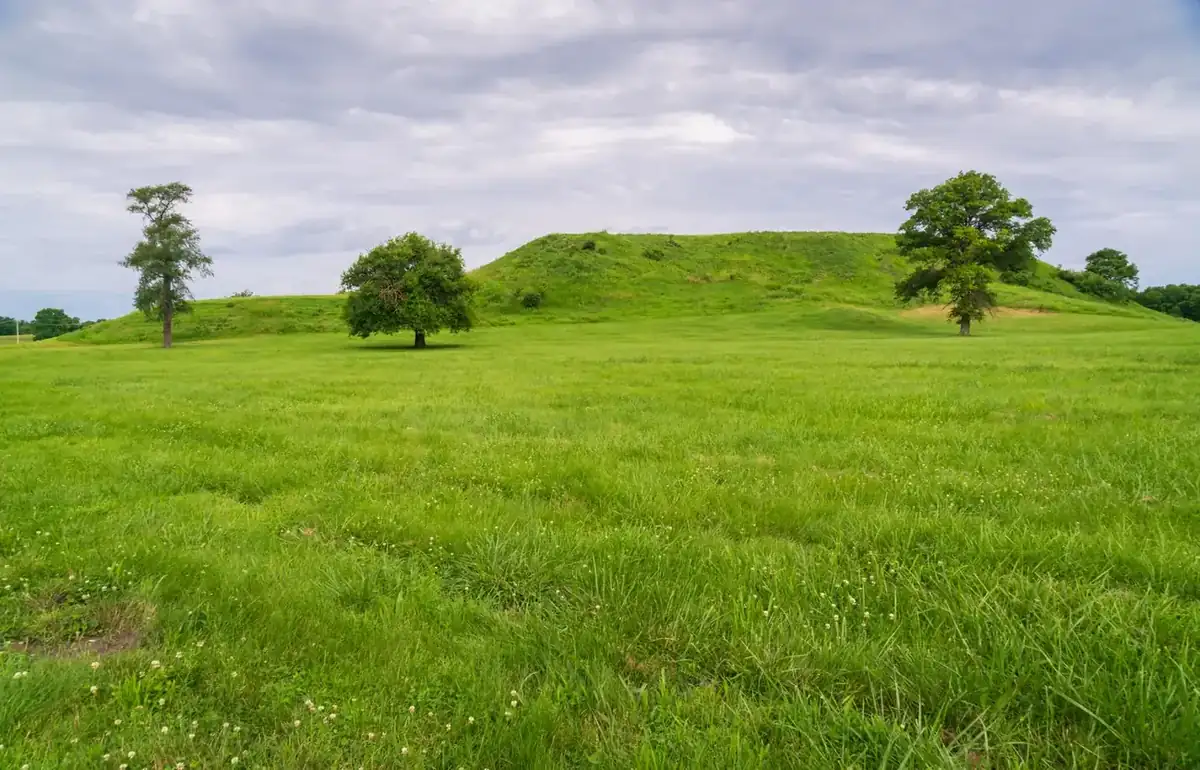
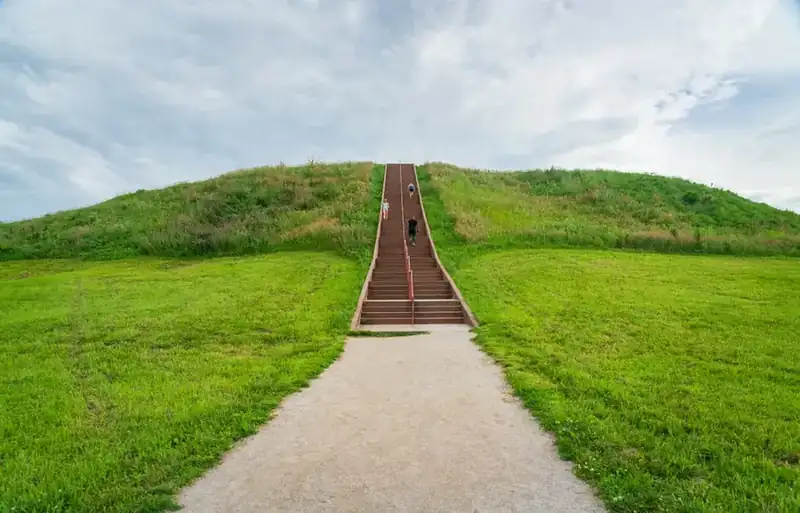
Eight miles east of St. Louis stands the largest earthen structure in the Americas. Monks Mound covers fourteen acres at its base and rises a hundred feet in four terraces, and it is only the biggest of roughly eighty surviving mounds from a city that once had more than a hundred and twenty. At its height around 1100 AD, Cahokia held more people than London did at the same moment. It was the largest city north of Mexico, and it would not be matched anywhere in what became the United States until Philadelphia in about 1800.
The people who built it left no written record, and the city emptied within two centuries for reasons still argued over: drought, deforestation, flooding, political collapse. What they left behind is a planned metropolis with a grand plaza, residential districts, borrow pits, and a circle of posts archaeologists call Woodhenge, aligned to mark the solstices and equinoxes. The scale of the earthmoving is difficult to take in. Monks Mound alone required moving an estimated twenty-two million cubic feet of soil in baskets.
Cahokia is a UNESCO World Heritage Site and a National Historic Landmark. It is not a unit of the National Park System. It is an Illinois state historic site, sitting beside a highway in a landscape of strip malls and rail yards, and the contrast between its global standing and its everyday surroundings is the first thing most visitors notice.
Since 2019 Representative Mike Bost and Senator Dick Durbin have pushed to make it a national historical park spanning Illinois and Missouri, linking Monks Mound with Sugarloaf Mound in St. Louis, the last surviving mound in that city, and other sites in three Illinois counties. The Interior Department has asked for a special resource study first, which is the federal way of saying not yet. The case is simple enough: if the largest ancient city in the country is not National Park material, it is hard to say what would be.
The scale is the part people refuse to believe. At its height, around the year 1100, the city held somewhere between ten and twenty thousand people, more than London at the same moment, and the mounds were not a village but a planned capital with a grand plaza, a palisade of thousands of logs, and an astronomical circle of cedar posts. More than a hundred and twenty mounds were built here; about eighty survive.
What sits on the rest of it is an interstate, a subdivision, and until recently a drive-in. Highway 55 and 70 run through the site's edge, Sugarloaf Mound across the river in St. Louis had a house on top of it until the Osage Nation bought the property back, and much of the old city is under pavement. A federal designation is partly an argument about buying back what can still be bought.
Tribal consultation is the reason this proposal reads differently from the rest of the list. The descendants of Cahokia are the Osage, the Peoria, the Quapaw, and others who were removed from this country, and the bills have been written with those nations at the table rather than about them. The Interior Department has testified in favor more than once. What it has not done is get floor time.
The history of National Park Campaigns
Cahokia, the largest pre-Columbian city north of Mexico, has been pushed since 2019 for a Cahokia Mounds Mississippian Culture National Historical Park spanning Illinois and Missouri, linking Monks Mound with Sugarloaf Mound in St. Louis and other sites. Rep. Mike Bost (R-IL) first filed in 2019; the bill has been reintroduced with Sen. Dick Durbin (D-IL) in 2021, 2023, and 2025. Interior recommended a special resource study first.
- Distinct National Park attempts
- 4+ (2019; 2021; 2023; 2025)
- Other designation attempts
- 0 (currently a state historic site, National Historic Landmark, and UNESCO World Heritage Site)
Sources
- DOI testimony on S. 2340 (2020) and S. 1211 (2022)
- congress.gov bill histories, 116th–119th Congresses
- Cahokia Mounds State Historic Site records, Illinois Historic Preservation Division
- Timothy Pauketat, Cahokia: Ancient America's Great City on the Mississippi (2009)
- July 30, 2019
S. 2340 (116th Congress) introduced; DOI testimony March 4, 2020.
- 2021
Reintroduced by Rep. Bost and Sen. Durbin as the Cahokia Mounds Mississippian Culture National Historical Park Act.
- September 21, 2022
DOI testimony on S. 1211 (117th Congress) recommends a special resource study before designation.
- 2023
Reintroduced; no floor action.
- April 2025
Durbin and Duckworth introduce a special resource study bill, shifting strategy to the study route Interior requested.