- Location
- Illinois
- Current protection
- Shawnee National Forest, Garden of the Gods Recreation Area, Lusk Creek Wilderness
- Status
- Active citizen campaign; no bill
- In the book
- Not featured in Undiscovered America
Why should it be a National Park?
The last glaciers stopped in southern Illinois. Everything north of that line was flattened into the farmland the state is known for; everything south of it was left alone, and what was left is a country of sandstone bluffs, box canyons, and hardwood forest between the Ohio and the Mississippi. The Shawnee National Forest covers about 289,000 acres of it, the only national forest in Illinois.
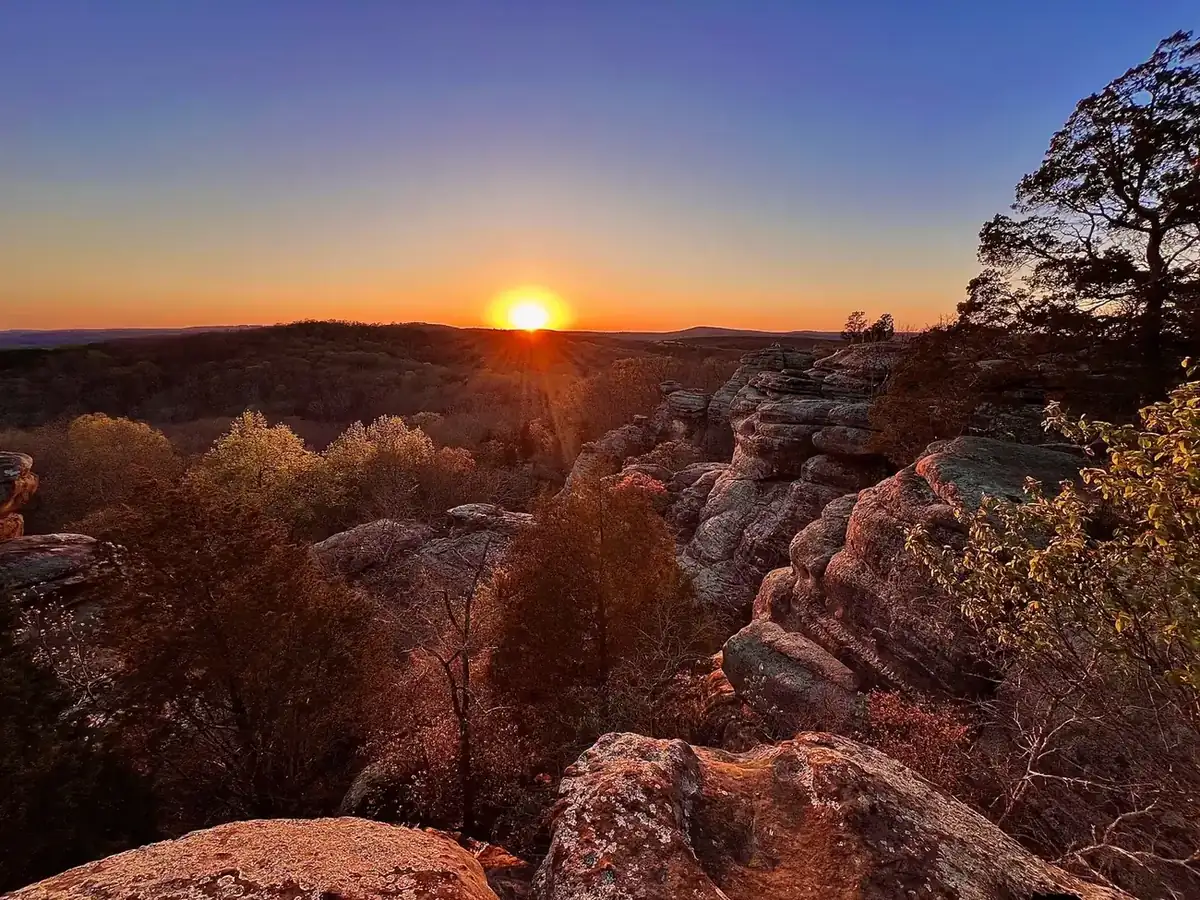
The Garden of the Gods is the place people photograph, a ridge of sandstone worn into towers and fins, with a quarter-mile flagstone trail along the top that the Civilian Conservation Corps laid. Elsewhere there is the Little Grand Canyon, Jackson Falls, Bell Smith Springs, and the Lusk Creek Wilderness. Cave-in-Rock is a cavern in a bluff above the Ohio that river pirates used in the 1790s to ambush flatboats. The Trail of Tears crossed here in the winter of 1838 and 1839, and Cherokee people died waiting for the ice on the Mississippi to break.
In April 2024 the path of a total solar eclipse crossed directly over this forest, as it had in 2017, putting southern Illinois under two totalities in seven years and bringing a few hundred thousand people to look at a place most of them did not know existed.
Since about 2022 a coalition has been pushing to transfer the whole forest from the Forest Service to the Park Service as a Shawnee National Park and Climate Preserve. The climate part is the novel argument: end commercial logging and let the forest accumulate carbon, with hunting and dispersed recreation continuing. Carbondale's city council endorsed it. No bill has been introduced, and county boards and timber interests are opposed. It is the only campaign in the country proposing a National Park primarily as a carbon reservoir, which makes it either ahead of its time or a category error, depending on who is asked.
Twice a year the Forest Service closes a road for snakes. The blacktop through LaRue-Pine Hills is shut every spring and fall so that thousands of snakes can cross between the limestone bluffs where they overwinter and the swamp where they feed. There is nothing else like it on federal land, and it is the clearest evidence of what this forest is: a place where northern and southern ranges overlap and species pile up.
The human history is harder. Cave-in-Rock on the Ohio was a river pirates' den before it was a state park, and in the winter of 1838 and 1839 detachments of the Cherokee on the Trail of Tears crossed southern Illinois in the ice, with the route and several camps running through country the forest now covers. A park proposal here inherits that story whether it wants to or not.
The obstacle is the map. The Shawnee's roughly 289,000 acres are a checkerboard inside a much larger proclamation boundary, mixed with private farms, oil and gas leases, and grazing allotments, the legacy of buying worn-out land back in the 1930s. Consolidating that into a park would take either a great deal of money or a great deal of time, and the timber and county interests that fought the logging wars of the 1990s are still there.
The history of National Park Campaigns
The Shawnee Park and Climate Alliance, led by John Wallace of Shawnee Forest Defense, is campaigning to transfer the roughly 289,000-acre Shawnee National Forest from the Forest Service to the National Park Service as a Shawnee National Park and Climate Preserve, which would be the nation's first climate preserve, ending commercial logging to maximize carbon storage while allowing hunting. Carbondale endorsed it in 2022; no federal legislation has resulted.
- Distinct National Park attempts
- 1 (2021–present; no bill)
- Other designation attempts
- 0 park-related
Sources
- Carbondale City Council Resolution 2022-R-58
- Shawnee Forest Defense and Shawnee Park and Climate Alliance materials
- NPR Illinois and Illinois Times coverage, 2022–2024
- c. 2021–2022
The campaign forms, sparked by a column by retired Southern Illinoisan editor Les Winkeler.
- December 13, 2022
The Carbondale City Council passes Resolution 2022-R-58 supporting redesignation, on a 5-1 vote.
- 2023–2024
Murphysboro and the Illinois Audubon Society join; the Alliance drafts legislation, aiming for introduction around the April 2024 eclipse. Sierra Club Illinois raises invasive-species and management concerns.
- Present
Advocacy stage; no bill introduced; county and timber interests opposed.