- Location
- Idaho
- Current protection
- Craters of the Moon National Monument & Preserve, Great Rift, Pioneer Mountains
- Status
- No active campaign
- In the book
- Featured in Undiscovered America
Why should it be a National Park?
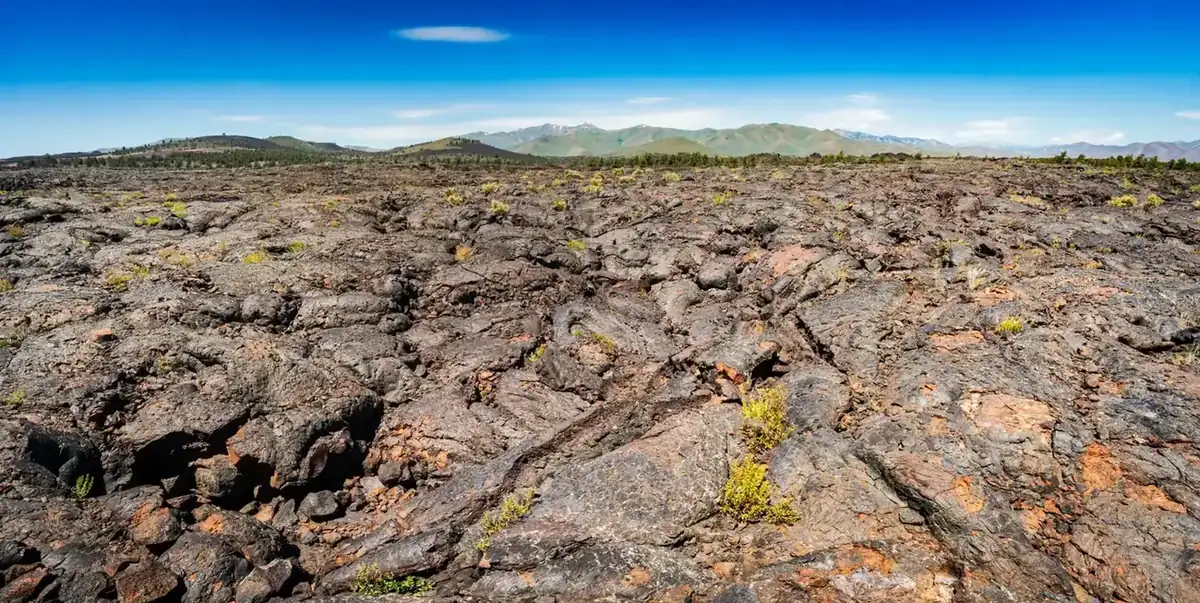
The iconic volcanic landscapes within the United States are on the Hawaiian Islands, but the often overlooked state of Idaho showcases more than 1,100 square-miles of the most diverse fields of dormant lava flows in the entire country. Hawaii does have a series of parks and preserves which represent volcanic environments, but it's time we reveal that Hawaii is not the only place in America with these features. Craters of the Moon is an unexpected, exemplary site worthy of greater recognition.
These volcanic lands in the Great Rift region of south-central Idaho consist of three enormous lava fields. The fields offer rare opportunities to experience rift cracks, which are massive crevices caused by the land splitting apart, including the deepest known one on Earth at 800 feet deep. Craters of the Moon also has an impressive variety of landscapes ranging from basaltic lava, to tree molds, and lava tubes. This eerie volcanic landscape resulted from a series of cataclysmic events roughly 15-million-years-ago, from the same geothermal hot-spot that sculpted the terrain of Yellowstone National Park.
After arriving at this landscape the first thing you will see are enormous cinder cones, lava formations surrounding volcanic vents, that rise as black hills, dwarfing the surrounding cracked ground. The park's frequent trails give visitors opportunities to see unique and impressive volcanic sites over short distances. Along the easily traveled loop road are lava cones with holes that maintain cold temperatures year round and contain snow, icy underground caves, isolated desert plant life ecosystems, and pillars of lava which look like demonic sculptures.
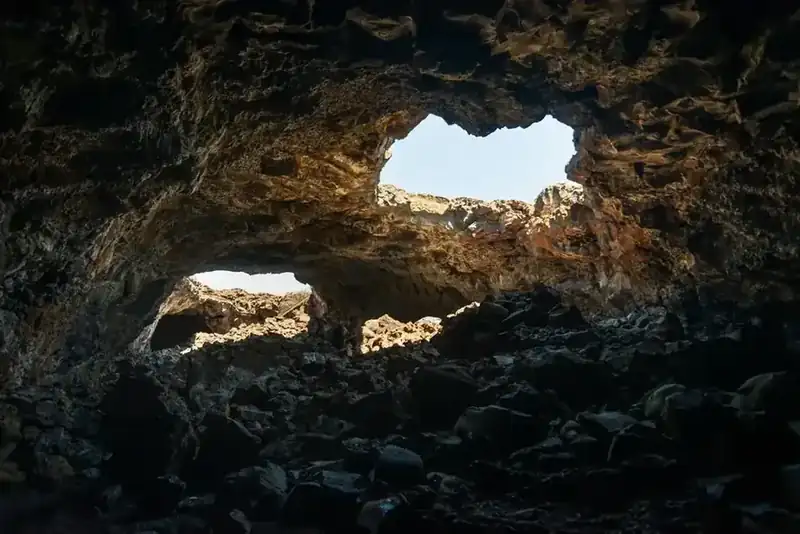
The highlight of Craters of the Moon is undoubtedly the several extensive, subterranean lava tubes. The tubes are remnants of free-flowing lava, which acted as subways for molten rock. These tunnel openings now remain as massive caves with self-guided trails, allowing visitors to explore the insides of volcanic features. The largest tubes have partially collapsed ceilings that illuminate the dark stone passageways, but flashlights are highly recommended when venturing underground.
A section of the Crater of the Moon environment was set aside as an NPS national monument in 1924, but in the early 2000s the monument was significantly expanded, including the addition of a National Preserve. Craters of the Moon is now co-managed by the BLM and NPS. This expansion carried with it policies that allow hunting and grazing on a substantial portion of the land.
Surprisingly, Idaho is the only western state without its own National Park. In recent years campaigns to change its federal designation have gained significant traction. In March 2017, the Idaho Senate voted in favor of petitioning Congress to redesignate Craters of the Moon as a National Park.
Craters of the Moon has been considered for redesignation as a National Park in 1921, 1987, 1989, and most recently 2017.
The history of National Park Campaigns
Craters of the Moon has been proposed for National Park status at least three documented times: by Rep. Richard Stallings in 1989–91 (a ~497,000-acre park-and-preserve bill that hunters, ranchers, and the National Park Service itself sank), by the monument's own superintendent in a 2014 feasibility effort, and by the Idaho Senate's 2017 memorial to Congress. In between, the monument was expanded twelvefold by President Clinton (2000) and Congress made the NPS-managed expansion a national preserve (2002) rather than a park.
- Distinct National Park attempts
- 3 documented (1989–91 Stallings bill; 2014 superintendent feasibility effort; 2017 SJM 101) — plus the book's 1921 and 1987 references,
- UNVERIFIED
- Other designation attempts
- monument 1924; four expansions; wilderness 1970; 2000 expansion; 2002 preserve
Sources
- NPS park archives index (npshistory.com/publications/crmo)
- Lewiston Tribune AP archive 1989–91
- Idaho Legislature SJM 101 (2017) record and Statement of Purpose
- P.L. 107-213
- Proclamation 7373
- Craters of the Moon administrative history (VERIFY title/author)
- 1920–24
Robert Limbert's expeditions and National Geographic article ("Among the 'Craters of the Moon'," March 1924) build the case; May 2, 1924 — Coolidge proclaims a ~54,000-acre national monument.
- 1928, 1930, 1941, 1962
boundary expansions; September 1958 — Adolph Murie's field investigation of the Kipuka addition (report Feb. 1959). (npshistory.com/publications/crmo)
- October 23, 1970
Craters of the Moon Wilderness, among the first NPS wilderness areas.
- November 1989
NATIONAL PARK BILL. Rep. Richard Stallings (D-ID) introduces a bill converting the 53,545-acre monument into a 496,825-acre Craters of the Moon National Park and Great Rift National Preserve, adding Crystal Ice Caves and the Great Rift (then BLM land already recommended for wilderness). Framed as an Idaho statehood-centennial project. Immediately attacked by sportsmen and the livestock industry; the Idaho Fish and Game Commission and the Idaho Cattle Association opposed it; Stallings withdrew and reworked it. (Lewiston Tribune/AP: "Stallings hopes National Park proposal is ready to go by May 1," 1990; "National Park idea is back on Stallings' agenda," 1991)
- 1990
Revised, smaller plan promised for May 1; in August Subcommittee Chairman Bruce Vento (D-MN) tells Stallings the National Parks and Public Lands panel has no time that session. Stallings: the November bill was "only a starting point for discussion, not a final product." (AP, "Craters of Moon park plan is stalled")
- Late 1990 / early 1991
NPS REPORT AGAINST. The National Park Service recommends against a National Park: the area's features, "although significant... fall short of meeting the criteria for National Parks," and resources "can be protected by revising Bureau of Land Management guidelines." Stallings says he will reintroduce only "if there is a state consensus and support... Otherwise I'll drop it," noting his 1990 opponent had called it "a land grab." (AP, "Stallings still pushing for National Park"; Lewiston Tribune)
- 1991
Vento visits Craters, is "impressed" but "not ready to endorse." Stallings runs for the Senate in 1992 and loses; the bill dies with his House career. (AP, "Lawmaker impressed by Craters of the Moon")
- November 9, 2000
Proclamation 7373 (Clinton) expands the monument to ~661,000 acres across NPS and BLM lands; August 21, 2002 — P.L. 107-213 (Rep. Mike Simpson) redesignates the NPS-managed expansion as Craters of the Moon National Preserve (hunting retained).
- November 2014
Superintendent Dan Buckley works with the NPS "on the feasibility" of National Park status and briefs the Idaho delegation; the Idaho State Journal runs "Craters of the Moon National Park?" (Nov. 2014). VERIFY outcome.
- March 2, 2017
Senate Joint Memorial 101 introduced (Idaho Senate State Affairs Committee; floor sponsor Sen. Jeff Siddoway, R-Terreton); March 6, 2017 adopted 20–13–2, over Idaho Farm Bureau opposition, conditioned on protecting grazing, hunting, and the state-owned US-20/26 corridor. Siddoway: "Our congressional delegation told us, 'Before we go forward with this, we want to make sure that the state is behind this.'" Never received an Idaho House vote. (legislature.idaho.gov SJM101; Spokesman-Review, Mar. 6, 2017; Boise Weekly)
- 2018
"Push to make Craters of the Moon a National Park stalls"; Siddoway retiring; idea not raised in the 2018 session. (Idaho State Journal)
- September 2024
Idaho State Journal op-ed revives the idea for the centennial; no bill. (2026 inventory)