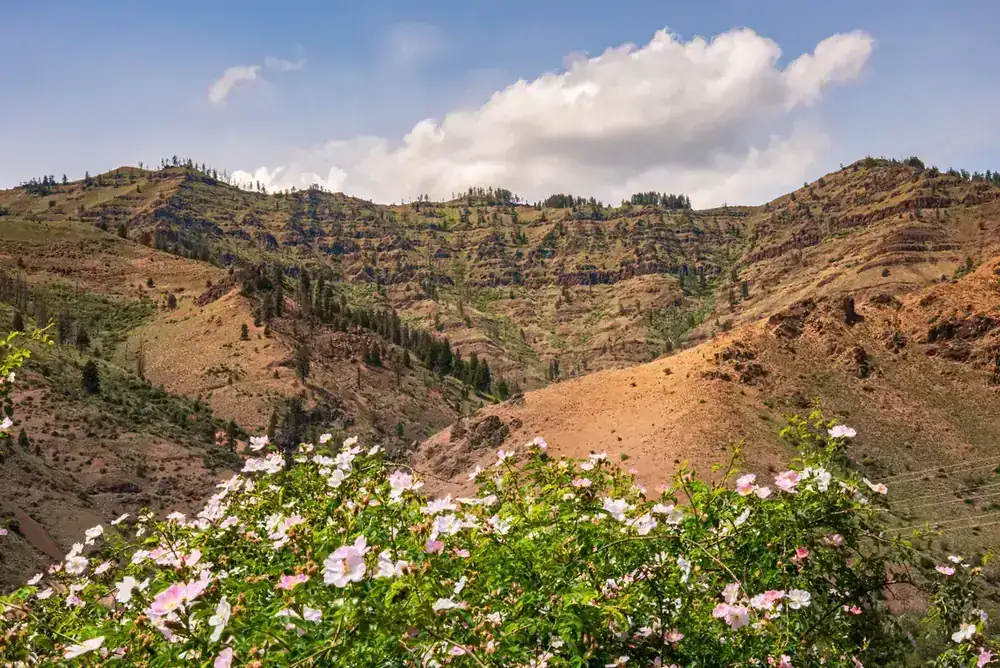
- Location
- Oregon/Idaho
- Current protection
- Hells Canyon National Recreation Area, Snake River, Brownlee/Oxbow dams & reservoirs
- Status
- No active campaign
- In the book
- Featured in Undiscovered America
Why should it be a National Park?
Many of America's most well-known natural attributes are famous because they had the tallest trees, largest thermal features, deepest lake, most petrified wood, biggest waterfalls, or several other incredible preeminent features. Therefore, you may assume that the Grand Canyon is the deepest canyon in the United States. However, that title belongs to the often ignored Hells Canyon on the border of Oregon and Idaho.
At its widest point, Hells Canyon is 10 miles across. The maximum depth is 7,913 feet compared to 6,093 feet for the Grand Canyon. A site of this scale and importance deserves to be a household name. However, its relative isolation in the undeveloped scrubland of the Pacific Northwest and its barren landscape make it difficult to visit without extensive planning. The closest major city is over 350 miles away, and neighboring communities have limited provisions and amenities for travelers.
The developed sections of the canyon consist mostly of long, steep, and difficult dirt roads. A high-clearance vehicle is recommended. Most of these roads lead to spectacular viewpoints that reward those willing to endure the journey. Unfortunately, many of the best views require at least half a day or overnight trips to experience.
This isolation is exactly why this site needs greater preservation. While it's easy to assume this distance from large populations would be good for its continued protection, the extraction of natural resources on public lands has been significantly expanding in recent years. The only chance a natural setting of this scale has to remain preserved into the future is to declare it off limits to industrial exploitation. When Yellowstone was preserved, there were also no large populations calling the neighboring areas home, but the wealth of minerals, natural gases, and animals would make it a site ripe for exploitation in an America without National Parks. A fate of exploitation and alteration is likely what lies ahead without the creation of a Hells Canyon National Park.
The Snake River started forming the canyon around 300-million-years-ago. The river also serves as the state border of Oregon and Idaho. Hells Canyon has been repeatedly considered for redesignation as a National Park, but none of these campaigns have been successful. This leaves the canyon at risk to industry influences that could cause the canyon being severely altered. Currently, the U.S. Forest Service provides the only land management of the area by overseeing roughly 650,000 acres of the canyon as a National Recreation Area, with roughly a third of that designated as wilderness. That leaves two-thirds of Hells Canyon at risk of having its natural splendor changed forever before most people even realize it exists.
Hells Canyon has flirted with National Park status for decades. Several organizations and politicians have looked at establishing a park here, like this 1993 study, but none have yet been successful.
The history of National Park Campaigns
Hells Canyon has drawn national-park attention four times: an NPS look in 1940 that Wallowa County beat back; the 1970–73 legislative war between park-style "National Forest Parklands" bills (Hatfield, Ullman) and the recreation-area bill that won in 1975; a 1992 conservation-coalition plan for a 1.5-million-acre "Hells Canyon National Park complex" with two National Parks; and a 2003 Hells Canyon Preservation Council proposal to transfer the area to the Park Service as a national preserve — explicitly not a park, to keep hunting.
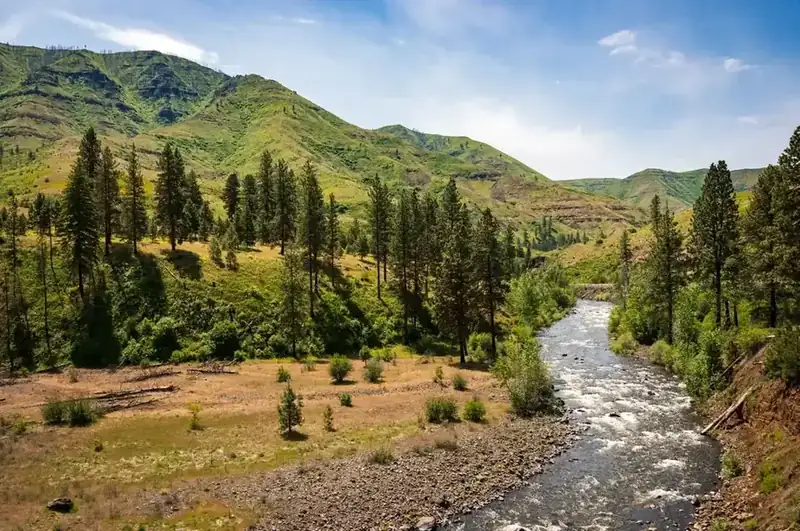
- Distinct National Park attempts
- 3 (1940 NPS interest; 1970–73 parklands bills; 1992 two-park complex proposal). Preserve/other: 2003 preserve project; 1975 NRA + wilderness + W&S
Sources
- P.L. 94-199 (89 Stat. 1117)
- 1973 House hearings (CHRG-93hhrg44629)
- Lewiston Tribune archive (1992)
- HCPC/Greater Hells Canyon Council records
- Brooks, Restoring the Shining Waters / Hells Canyon dam-fight histories
- 1940
NPS eyes a National Park; Wallowa County opposes ("runs head on, like a locomotive collision, into the economics of Wallowa County"). (prior research; VERIFY source)
- 1955–1975
Dam wars: Idaho Power's three-dam complex (Brownlee 1958, Oxbow 1961, Hells Canyon 1967); Mountain Sheep and Pleasant Valley dams proposed 1955; the Supreme Court's Udall v. FPC (1967) and the Wild and Scenic Rivers Act (1968) stall them. (Wikipedia; Hells Canyon)
- 1970–1973
competing bills. Sen. Mark Hatfield's S. 657 and Rep. Al Ullman's H.R. 2624 ("National Forest Parklands") vs. the NRA bill S. 2233 (Church, Hatfield, Packwood, McClure); House hearings 1973 (govinfo CHRG-93hhrg44629). (prior research)
- December 31, 1975
P.L. 94-199 (S. 322) establishes the Hells Canyon National Recreation Area (652,488 acres), the Hells Canyon Wilderness (~215,000 acres), and Wild & Scenic status for the Snake from Hells Canyon Dam to Pittsburg Landing (wild, 31.5 mi) and downstream (scenic, 36 mi); deauthorizes Asotin Dam. House vote 342–53. (89 Stat. 1117; S. Rept. 105-78)
- February 1992
"HELLS CANYON NATIONAL PARK COMPLEX." The Hells Canyon Preservation Council, Oregon Natural Resources Council, and NPCA unveil (press conferences in Lewiston, Portland, and Washington, D.C.) a 1.5-million-acre tri-state complex: two National Parks (High Wallowas and Hells Canyon), a national preserve, and a redrawn NRA from Brownlee Dam ~100 miles north to the Grande Ronde; it would transfer the NRA and Eagle Cap Wilderness to the NPS, add ~300,000 protected acres, and ban logging and mining in the NRA. Retired NPS official Paul Fritz (Boise) led the pitch; the groups asked Congress to fund an NPS study. (Lewiston Tribune, Bill Loftus, Feb. 1992) — this is likely the "1993 study" cited in the book. VERIFY whether Congress funded any study.
- 1997
S. 360 (jet-boat access) shows the NRA's management fights continuing. (S. Rept. 105-78)
- August 2003
"Hells Canyon–Chief Joseph National Preserve Project." HCPC (executive director Bailey) announces a plan to transfer the NRA and Eagle Cap to the NPS as a preserve, not a park — "Hunting, which is banned in National Parks, would be allowed in a preserve" — with a two-year public campaign before seeking a bill; Wallowa County Commissioner Ben Boswell and Wallowa-Whitman NF officials express surprise. (La Grande Observer/Baker City Herald, Aug. 28, 2003)
- 2020s
Greater Hells Canyon Council (HCPC's successor) focuses on restoration; no park bill.