- Location
- Oregon
- Current protection
- Silver Falls State Park, Willamette National Forest, Detroit Lake
- Status
- No active campaign
- In the book
- Featured in Undiscovered America
Why should it be a National Park?
Silver Falls State Park is one of the best state parks in America, So good in fact it has been considered for inclusion as a National Park on several occasions.
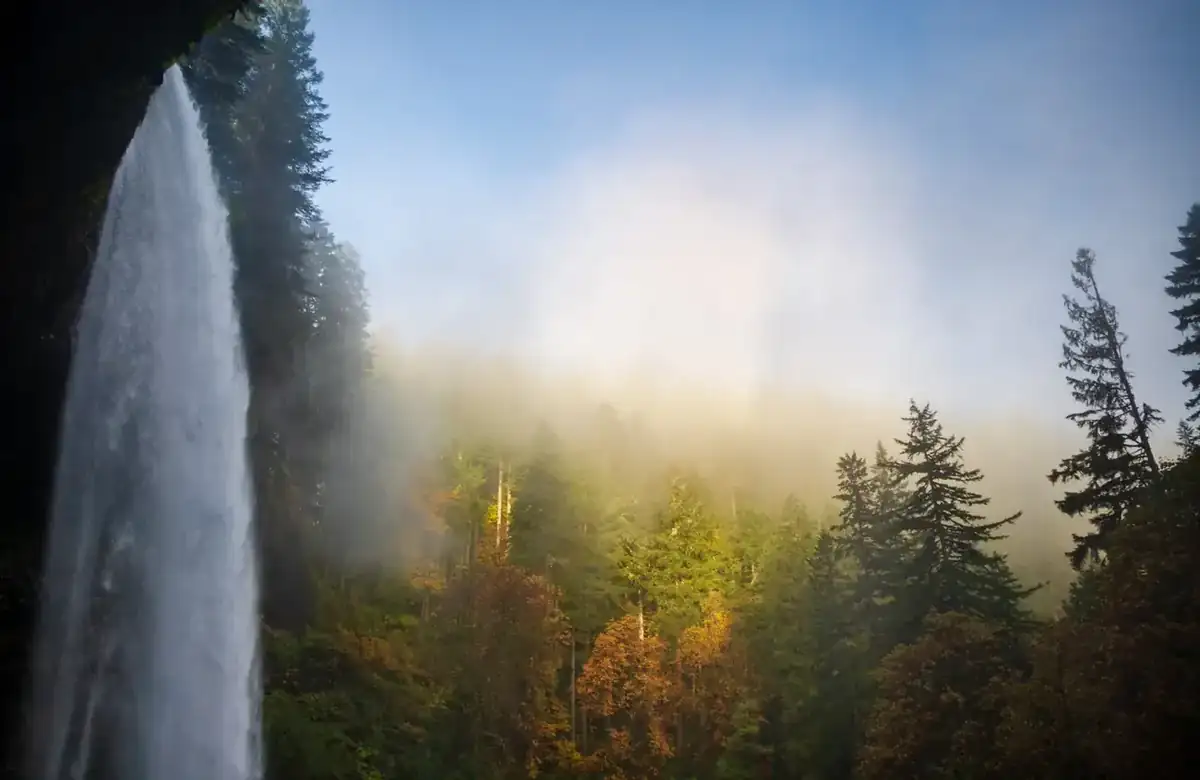
Located 23 miles east of Salem, this wonderland of trees, waterfalls, and trails is an ideal place to reach nature without having to head too far away from civilization. The park can be experienced via scenic overlooks, hiking trails through a canyon system, or atop a forested plateau. Early risers can be treated to a sunrise which offers breathtaking views as light filters in through the towering pine forests.
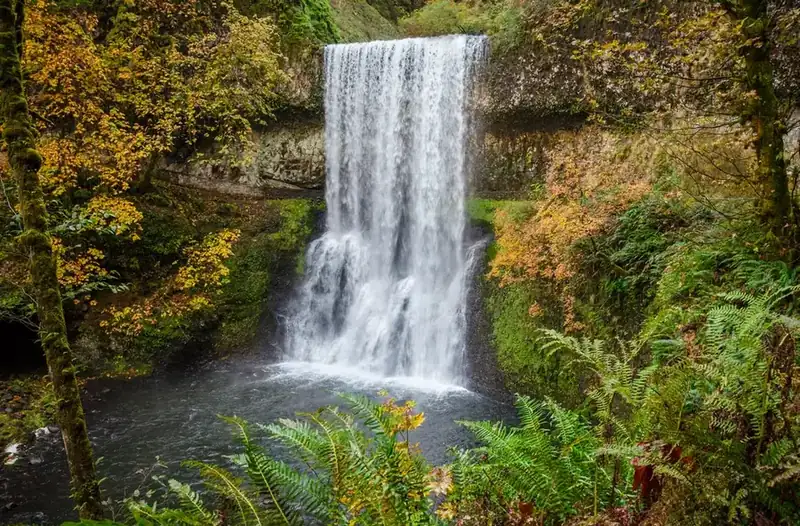
The Trail of Ten Falls is the principal attraction. This spectacular trail weaves through a densely forested landscape, passing a series of breathtaking waterfalls through a rocky canyon. After descending the canyon, the trail follows the banks of several creeks, crossing several rustic wooden bridges. This 7.2 mile loop is considered a moderate hike, with an overall elevation change of 800 feet. Several connecting trails with separate access points make for shorter routes if visitors only have time to see a handful of the waterfalls, rather than all ten.
The most famous of the falls is the namesake, South Falls. In addition to being an impressive 177 foot drop, the Trail of Ten Falls shepherds hikers behind its curtain of water so you can walk behind the falls. For those with mobility issues, the trail is very steep and wet. This is still a waterfall worth visiting as a viewing deck is available above the falls, which allows visitors to see the massive plunge the falls takes into the forested canyon below.
Back atop the plateau, a three-and-a-half-mile mostly paved bike path guides you through beautiful meadows and pine forests. Although no falls can be seen from the bike trail, it's still a great loop. There's also the Catamount Trail, which has over four-miles of hardcore mountain biking trails with some jumps.
The park is popular so if you're looking to see this beautiful location without being overwhelmed by seasonal tourists visit on weekdays. The park has 35 miles of backcountry trails available for mountain biking, hiking, or horseback riding, but keep in mind that bears, mountain lions, and coyotes live in the more remote areas of the park.
June Drake, a local photographer, relentlessly campaigned for federal protection of the land. His dream was to preserve Silver Falls as a National Park. While Drake did not achieve this dream, he helped to get the area its current state park status, saving its lush forests from logging. Many of his pictures are on display at South Falls Lodge. Drake was not the last person to advocate for making this place a National Park. The most recent push was in 2008 when Fred Girod of the Oregon House of Representatives pushed for the creation of a National Park with the U.S. Congress, but the bill died in committee.
Silver Falls has been pitched as a National Park dating back to 1926. As recently as 2008, Fred Girod of the Oregon House of Representatives sought federal designation of the area as a National Park via a house joint memorial to the United States Congress, but the bill died in committee.
The history of National Park Campaigns
Silver Falls was rejected by the National Park Service in 1926 — Sen. Charles McNary had offered 2,746 acres; the inspector saw a logged-over landscape whose stumps looked "like so many dark headstones" — and June Drake redirected his campaign into Oregon's young state park system (park adopted April 2, 1931). Then the federal government came back: in 1935 Roosevelt made Silver Creek one of only two Recreational Demonstration Areas on the West Coast, and the NPS ran the 6,000-acre RDA east of Highway 214 until deeding it to Oregon in 1947–48, when the two halves were united as Silver Falls State Park. A 2008 Oregon legislative memorial asking Congress for National Park status died in committee.
- Distinct National Park attempts
- 2 (1926 McNary/NPS inspection; 2008 legislative memorial), plus the 1920s–30s
- Drake campaign that produced them
- Other designation attempts
- state park 1931; federal RDA 1935–47
Sources
- Zeb Larson, "Silver Falls State Park and the Early Environmental Movement," OHQ 112:1 (Spring 2011) — the definitive account
- NPS, Silver Creek RDA Master Plan Report (April 1940
- Oregon SHPO)
- Oregon Encyclopedia, "Silver Falls State Park"
- Statesman Journal, "Why Silver Falls didn't become a National Park"
- 16 U.S.C. §459r–t
- c. 1900
Silverton photographer June D. Drake begins campaigning for a National Park, circulating his photographs as far as Congress. (Zeb Larson, "Silver Falls State Park and the Early Environmental Movement," Oregon Historical Quarterly 112:1, 2011; Oregon Encyclopedia)
- 1920s
"The NPS first considered Silver Falls as a National Park during the 1920s. Drake was a primary instigator." (Larson, OHQ)
- August 7, 1926
NATIONAL PARK PROPOSAL. Sen. Charles L. McNary (R-OR) proposes 2,746 acres of Silver Creek Falls to the NPS for a National Park; the NPS inspector rejects it because logging had left "thousands of stumps that from a distance look like so many dark headstones," and the Service recommends a state park instead. Drake identified the government's three objections: "the state of the land, the divided up parcels of land, and the insufficient size." (inlandnwroutes.com timeline; Larson)
- 1929–1931
State park idea approved (1929); Drake gets the Salem Chamber of Commerce to option land; April 2, 1931 — Silver Creek Falls formally adopted as a state park (nine falls); state buys the Geiser (South Falls) property with Drake's help; 1933 dedication before 5,000 people (1,268 acres). (Larson; inlandnwroutes)
- December 15, 1934
Emergency Conservation Work (CCC) crew begins; December 31, 1934 — federal Recreational Demonstration Area established; 1935 — FDR announces ~6,000 acres of farmland and cutover forest around the falls as the Silver Creek RDA, "one of only two on the West Coast," with the Resettlement Administration buying the land and the NPS developing it (South Falls Lodge, group camps). (Oregon Encyclopedia; Statesman Journal via Yahoo, June 2026)
- 1935–1947
Two parks side by side: Silver Creek Falls State Park (west) and the NPS-run Silver Creek RDA (east); April 1940 — NPS Silver Creek Recreational Demonstration Area, Master Plan Report. (Larson, citing the plan)
- June 6, 1942
RDA disposition act; July 30, 1947 — Act (61 Stat. 519) adds revested O&C lands to the Silver Creek project for transfer to Oregon; 1947–48 — NPS deeds the ~6,000-acre RDA to the state; the united park is renamed Silver Falls State Park (1948). (16 U.S.C. §459r note; Statesman Journal)
- January 2008
Rep. Fred Girod's House Joint Memorial asking Congress for National Park status dies in committee. (prior research; VERIFY HJM number)
- 2020
Beachie Creek Fire burns the adjacent Santiam State Forest and Opal Creek; park largely spared.