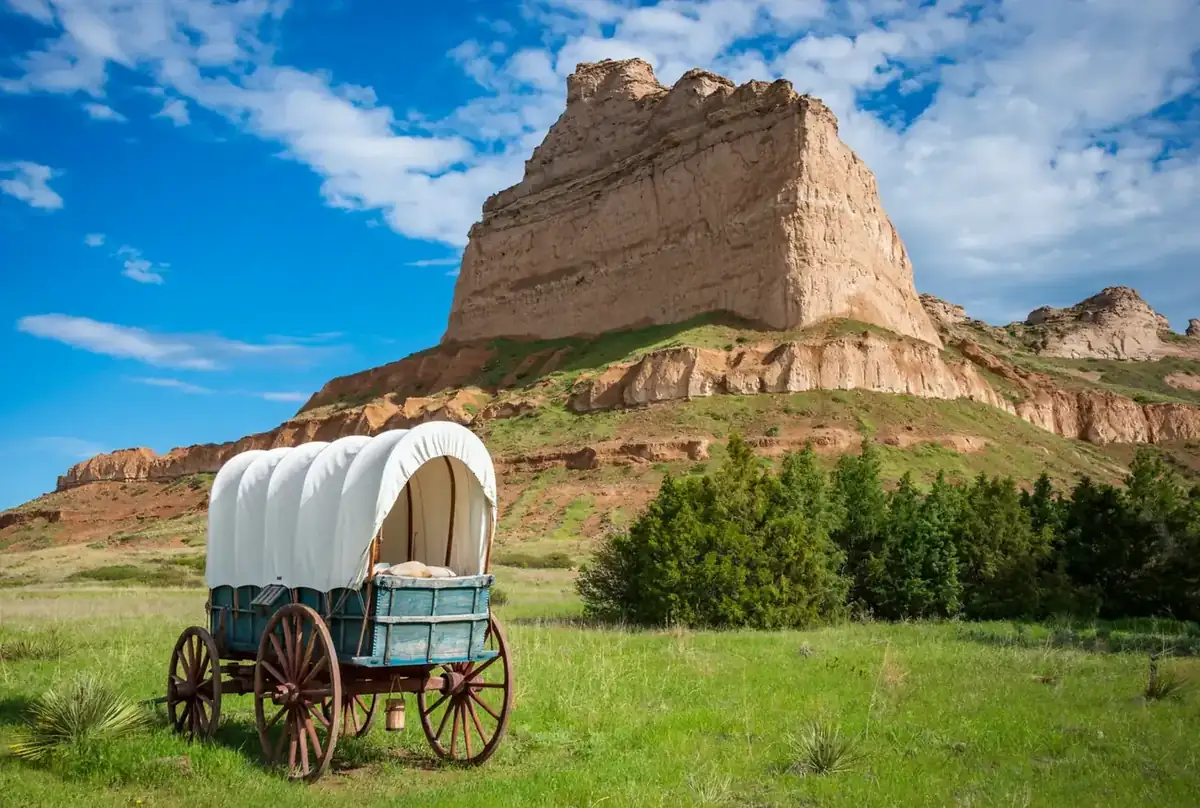
- Location
- Nebraska
- Current protection
- Scotts Bluff National Monument, Chimney Rock National Historic Site, Courthouse & Jail Rocks
- Status
- No active campaign
- In the book
- Featured in Undiscovered America
Why should it be a National Park?
Since establishing the world's first National Park in 1872, the United States has set aside 62 National Parks. The majority of those are in the western states, with a handful dotted across the east. Between these two clusters of parks is the open expanse of the Great Plains, which has been historically overlooked by naturalists and conservationists. The plains were once made up of massive prairies and grasslands that extended west from parts of Indiana to the Rocky Mountains. Much of this land has been developed by homesteaders into agricultural farmland, however, a few special landscapes have endured in their natural state. One of these regions is the Wildcat Hills, an escarpment that extends 45 miles from western Nebraska to the Wyoming border.
During the 19th Century, gold rushes in California and Alaska alongside federal legislation like the Homestead Act, offered financial and land incentives to anyone brave enough to move into the unsettled western territories. A network of towns, forts, and trails soon emerged. The California, Mormon, and Oregon Trails, known collectively as the Emigrant Trails, started in Missouri and traveled through modern-day Nebraska. The trails weave by a series of landmarks such as Chimney Rock, Scotts Bluff, Fort Laramie, and Independence Rock, which have become part of the American mythos.
While Scotts Bluff and Chimney Rock are well-known, most people are unaware that they are actually part of the Wildcat Hills, a larger region of bluffs, buttes, and other rock formations. As the plains' states were settled, a sizable population began to live in and farm this fertile region. Steps were taken to preserve some of the more well-known natural features. Consequently, Scotts Bluff was designated a National Monument in the National Park Service, and Chimney Rock was categorized as an affiliated area of the National Park Service run by the Nebraska State Historical Society.
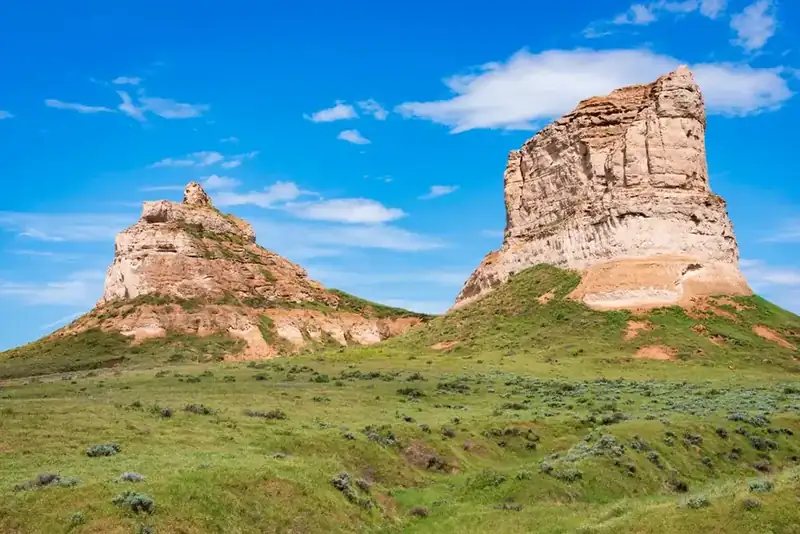
These white monuments stand like a sun-bleached cousin of Monument Valley, rising up through the prairie seemingly at random. The Wildcat Hills are actually a plateau that is slowly eroding into these impressive buttes. Scotts Bluff is the centerpiece of the range, and at 800 feet it proudly towers above the Nebraska Panhandle region. Another unique feature of the Hills are the small forested stretches along the range. The chalky edges of the plateau can be seen through the trees, adding to the unique contrast of green trees, yellow grasses, and white rock formations.
In addition to the iconic natural landscapes, the Wildcat Hills contain many buttes and bluffs that go without recognition and notoriety because they lack the romantic names of the iconic sites, despite dwarfing them in size. Areas such as Monument Valley or Meteora in Greece are seen and appreciated as a collection of natural features, while the Wildcat Hills are denied this cohesive understanding because only a handful of its most recognizable features became part of the national identity.
The history of National Park Campaigns
Gering citizens asked Interior about a national monument in 1914, petitioned the new National Park Service on October 5, 1916, and again in March 1918; Wilson proclaimed Scotts Bluff National Monument on December 12, 1919. The only later federal expansion idea was an early-1970s NPS "Professional Service Proposal" to fold Chimney Rock and Robidoux Pass into the monument, never enacted. No National Park was ever sought.
- Distinct National Park attempts
- 0
- Other designation attempts
- monument 1919 (petitions 1914–18); boundary changes 1924/1932/1940; NHS 1956; 1970s expansion proposal
Sources
- NPS, Scotts Bluff National Monument: An Administrative History (Merrill Mattes/successor, online at nps.gov/parkhistory/online_books/scbl)
- Nebraska State Historical Society RG 532 (Scotts Bluff records, 1932–76)
- Mattes, Scotts Bluff (NPS Historical Handbook 28, 1958)
- March 28, 1914
Inquiry to Interior about a national monument at Scotts Bluff; October 5, 1916 and March 1918 — citizen petitions to the NPS for a monument "commemorating the Oregon Trail." (scienceviews.com summary of NPS history)
- December 12, 1919
Proclamation 1547 (41 Stat. 1779): Scotts Bluff National Monument, 2,053 acres; first Antiquities Act use for a westward-expansion landscape. (nps.gov/scbl)
- May 9, 1924
EO 4008 removes 160 acres; June 1, 1932 — Proclamation 1999 adds ~1,346 acres; March 29, 1940 — Proclamation 2391 adds 53 acres.
- 1933–39
CWA/CCC build the Summit Road, museum (Oregon Trail Museum, 1935–36).
- June 5 / August 9, 1956
Chimney Rock designated a National Historic Site under a state–NPS–City of Bayard agreement (state-owned 83 acres). (NPS Scotts Bluff administrative history, ch. 4)
- Early 1970s
NPS "Professional Service Proposal" to incorporate Robidoux Pass and Chimney Rock into Scotts Bluff NM; not enacted. (NPS adhi ch. 4)
- 1978
Oregon National Historic Trail; 1992 — California, Pony Express NHTs; Wildcat Hills SRA (state, 1930s–) and Nature Center (1995).