- Location
- New Mexico
- Current protection
- Bandelier National Monument, Bandelier Wilderness, Valles Caldera National Preserve (adjacent)
- Status
- Bill proposed in 2019; dormant
- In the book
- Not featured in Undiscovered America
Why should it be a National Park?
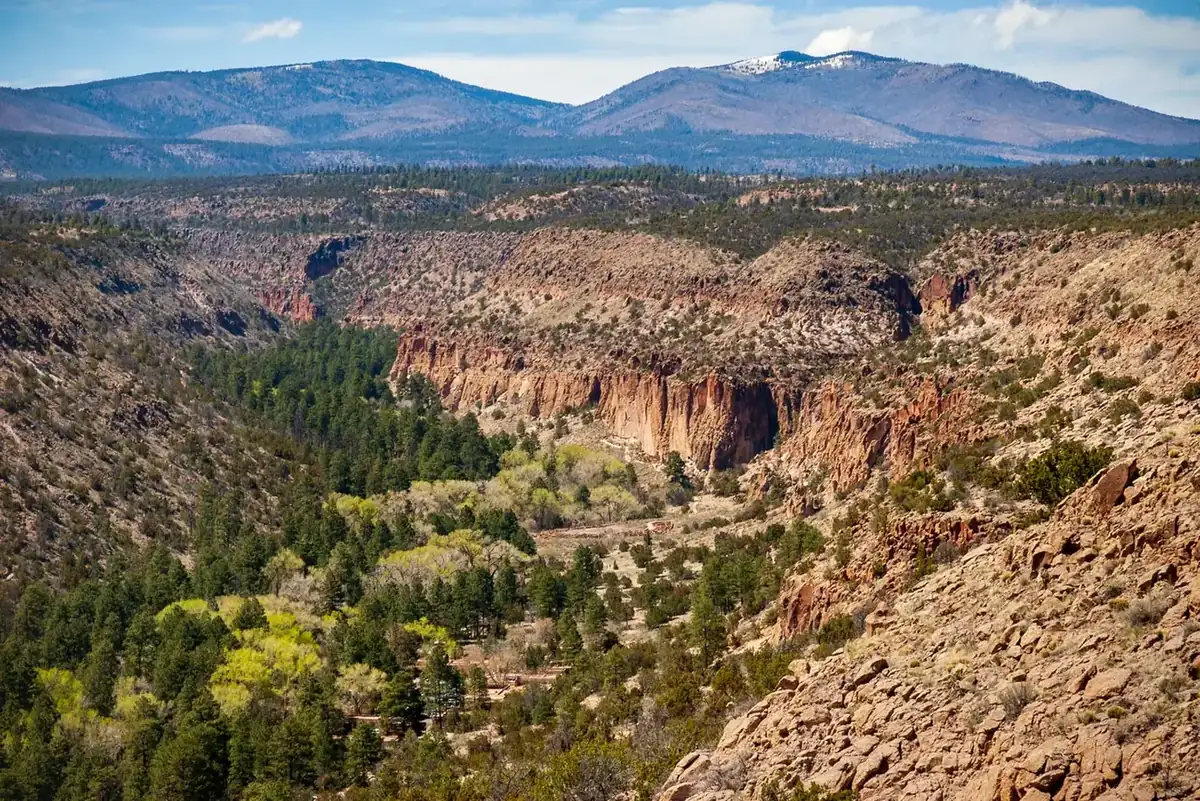
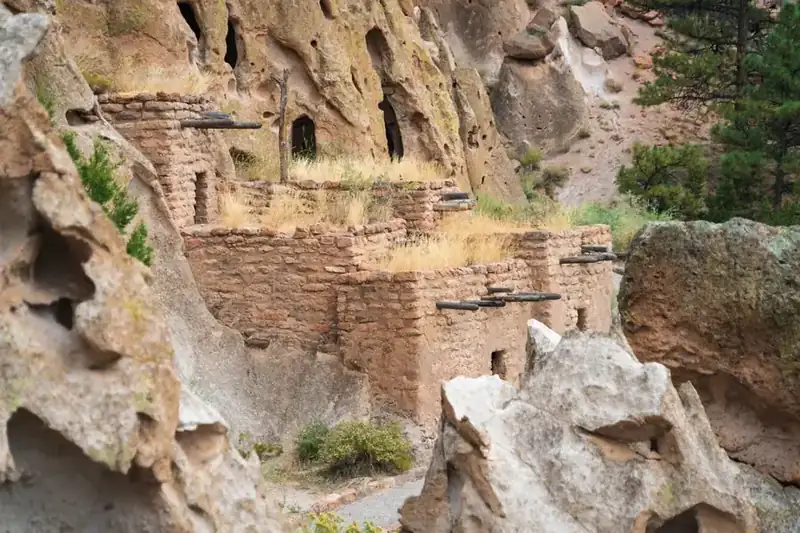
Frijoles Canyon cuts through volcanic tuff on the Pajarito Plateau, and into the soft rock of its walls the Ancestral Pueblo people carved rooms. They are still there, hundreds of them, reachable by ladder from the canyon floor. Bandelier protects more than 33,000 acres of this country, most of it designated wilderness, on the flank of a volcano that collapsed into one of the largest calderas on the continent.
The people who built here did not vanish. Their descendants live in the pueblos along the Rio Grande, and Cochiti, San Ildefonso, Santa Clara, and others maintain active ties to these canyons. The monument is named for Adolph Bandelier, the Swiss-American scholar who documented the sites in the 1880s, but the naming obscures a longer story of continuous Pueblo presence that no European arrival interrupted.
Bandelier was proposed as a National Park before it was made a monument. From about 1900 through the 1920s, a campaign for a National Park of the Cliff Cities produced a string of congressional bills backed by the archaeologist Edgar Hewett. Every one failed, blocked by the Forest Service and by disputes over boundaries. Wilson proclaimed the monument in 1916 as the compromise, and for its first sixteen years the Forest Service ran it.
In 2019 Senator Martin Heinrich proposed finishing the job: redesignating Bandelier a National Park and preserve, with a commission of affiliated pueblos advising on management, a ban on drilling and extraction, and a preserve unit on the northwest side where hunting would continue alongside the neighboring Valles Caldera. He paired it with a plan for White Sands, which became a National Park that same year. Bandelier did not. The proposal remains on the table, and it would make the tribal-advisory model central rather than incidental to how an American National Park is run.
The history of National Park Campaigns
Efforts to protect the Pajarito Plateau's cliff dwellings as a National Park of the Cliff Cities ran from roughly 1900 through the 1920s, championed by Edgar Hewett and repeatedly blocked. The compromise was Bandelier National Monument, proclaimed February 11, 1916, and managed by the Forest Service until 1932. Sen. Martin Heinrich revived the park idea in 2019 with a National Park and preserve bill featuring a tribal commission; it has not been enacted.
- Distinct National Park attempts
- 5+ (c. 1900; c. 1902; 1914; 1917; 1919; 2019)
- Other designation attempts
- 3 (monument 1916; wilderness 1976; boundary increase 2014)
Sources
- Hal Rothman, Bandelier: An Administrative History (NPS, 1988)
- Edgar Hewett, 'The Proposed National Park of the Cliff Cities,' El Palacio 3 (April 1916)
- NPS Proposed National Park file 0-32, Cliff Cities, RG 79, National Archives
- Sen. Martin Heinrich press releases, 2019–2020
- c. 1900
A bill to create a Cliff Cities National Park is introduced and fails.
- 1900–1916
Successive Cliff Cities and Pajarito park proposals, documented in the NPS 'Proposed National Park file 0-32, Cliff Cities' (RG 79) and in Edgar Hewett, 'The Proposed National Park of the Cliff Cities,' El Palacio 3 (April 1916). All blocked by Forest Service resistance and boundary disputes.
- February 11, 1916
President Wilson proclaims Bandelier National Monument; administered by the Forest Service.
- 1932
Monument transferred to the National Park Service.
- October 1976
Bandelier Wilderness designated.
- November 21, 2019
Sen. Martin Heinrich (D-NM) announces a Bandelier National Park and Preserve bill: a roughly 4,000-acre preserve unit open to hunting and managed with Valles Caldera, a tribal commission of affiliated pueblos, a prohibition on extraction, and traditional knowledge required in planning.
- March 5, 2020
Senate Energy and Natural Resources National Parks Subcommittee hearing; no enactment.