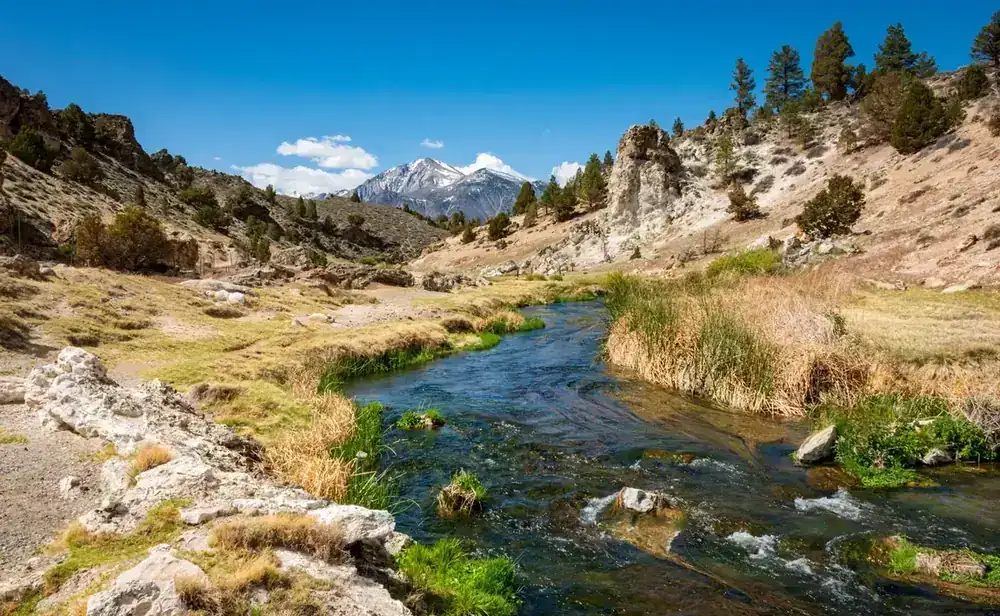
- Location
- California
- Current protection
- Inyo National Forest, Bodie State Historic Park, Benton Crossing Rd
- Status
- No active campaign
- In the book
- Featured in Undiscovered America
Why should it be a National Park?
The Sierra Nevada Mountains are one of the country's most celebrated mountain ranges, but only a small percentage of the people visit the desert on the eastern side of the range and experience the secret wonders there.
Hot Creek is a taste of Yellowstone in the high desert. The creek is located within the Long Valley Caldera, a 20 mile-wide depression created by the collapse of a volcano over 700,000-years-ago. The warm, geothermal waters carved a gorge through the caldera, offering expansive views of the eastern slope of the Sierras along with several strange rock formations, pools, steam vents, and hot springs. Although it's less than an hour away from Yosemite's eastern entrance, Hot Creek is virtually unknown. The Inyo National Forest, which manages Hot Creek and the Mono–Inyo volcanic craters to the north, receives minimal federal funding and has difficulty even maintaining safety measures like fences to ensure visitors are safe around dangerous volcanic features.
North of Hot Creek is a chain of volcanic domes and craters called the Mono-Inyo Craters that extend 25 miles along the foot of the eastern Sierra Nevada range. This collection of volcanic cinder cones and dark, forested craters contrasts with the mountains to the west, the rugged desert caldera to the south, and the bright white tufa formations of Mono Lake to the north.
Mono Lake is theorized to have been created hundreds of thousands of years ago when the basin where it lies was filled with water. Without an outlet to the ocean, the water was trapped and has been slowly evaporating away. With every passing year, the salinity of the lake increases as the water level drops, resulting in white limestone tufa formations that made the lake famous. Sadly, visitors regularly trample the delicate limestone towers as they climb on them and take pieces of tufa for souvenirs, endangering this natural wonder.
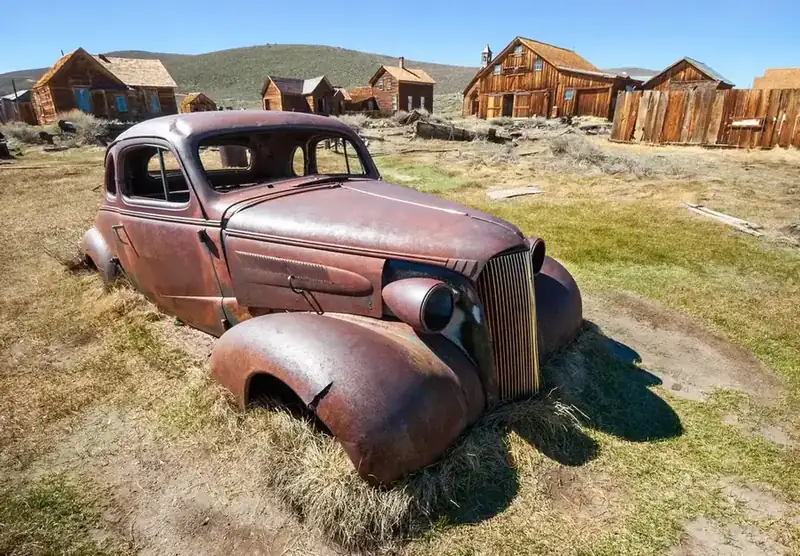
Fifteen-miles north of Mono Lake lies Bodie State Historic Park. Although its name might not be as resonant as ghost towns such as Deadwood or Tombstone, Bodie is by far the largest and best-preserved ghost town in the country. At its height in the 1870s, this boomtown had 8,500 residents hoping to get-rich-quick from nearby gold and silver deposits. By 1886, the population dropped to 1,500. In the early 1900s, the town's population dwindled to almost nothing. Entire houses full of possessions were abandoned, and for a while, the town just sat rotting and decaying. The town was saved when it was designated a National Historic landmark in 1961 and purchased by the state in 1962. California has preserved it in a state of "arrested decay" ever since. During the 2011 California budget crisis, the state threatened to shutter up to 70 state parks, including Bodie. Conservationists called for the federal government to take over the park, but the budget crisis ended before that could happen.
The history of National Park Campaigns
Mono Lake's defenders chose designations they could win: a state reserve (1981) and the nation's first national forest scenic area (1984). Bodie went from National Historic Landmark (1961) to state historic park (1962). The Bodie Hills surfaced on a 2010 Interior list of monument candidates and were never designated. No National Park has been proposed.
- Distinct National Park attempts
- 0
- Other designation attempts
- state reserve 1981; scenic area 1984; monument-candidate list 2010
Sources
- John Hart, Storm over Mono (1996)
- Mono Lake Committee archives
- P.L. 98-425 legislative history
- 1941
Los Angeles begins diverting Mono Basin streams (Grant Lake/Lee Vining).
- 1961 / 1962
Bodie NHL; Bodie State Historic Park.
- 1978
Mono Lake Committee founded (David Gaines).
- 1981
Mono Lake Tufa State Reserve.
- 1983
National Audubon Society v. Superior Court (public trust doctrine).
- 1984
Mono Basin National Forest Scenic Area (California Wilderness Act of 1984, P.L. 98-425), the first of its kind. (VERIFY 1984–86 bill numbers)
- 1994
State Water Board Decision 1631 sets Mono Lake's target level.
- 2010
Bodie Hills on a leaked Interior monument-candidate list; Rep. Buck McKeon's H.R. 6129 to release the Bodie WSA; 2009–11 state budget crisis threatens Bodie SHP.
- 2020s
Bodie Hills exploration fights continue; no park proposal.