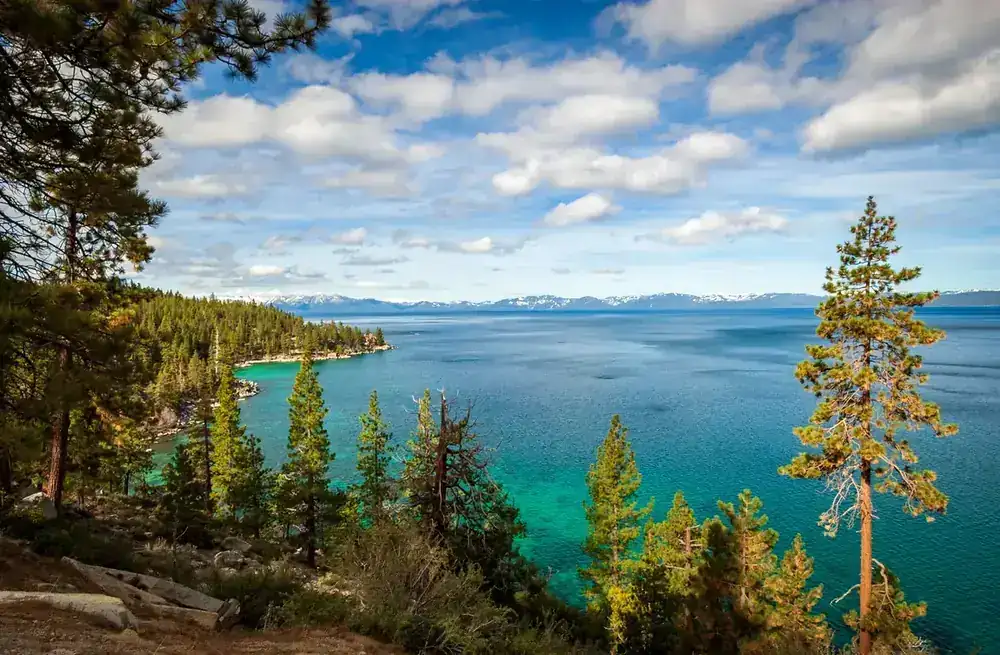
- Location
- California/Nevada
- Current protection
- Emerald Bay, Sand Point/Sand Harbor & Spooner Lake, Eldorado National Forest
- Status
- No active campaign
- In the book
- Featured in Undiscovered America
Why should it be a National Park?
Most people believe Lake Tahoe is already a National Park. The reasons for its lack of a corresponding designation vary, but the underlying reality is that this country should do a better job of protecting landscapes that define America before they are overrun by development, which would exploit the natural splendor for profit.
For over one hundred years, conservationists have been trying to better protect Lake Tahoe. John Muir was one of the early proponents for this mountain lake and wanted it established as a National Park in the late 1800s. I imagine he would be extremely disappointed with logging practices that enabled the shoreline to fill up with hotels, casinos, and other tourist industries. While it would be easy to assume that no hope remains for creating a National Park here today, especially if you've visited yourself, what you may not know is a substantial portion of the Tahoe area is shielded from future encroachment in the form of national forests and state parks.
The massive freshwater lake is 22 miles by 12 miles along the California and Nevada border, with most of the unspoiled lands located on the California side. The Nevada portion is mostly developed, with small pockets of state park land scattered throughout. Despite all the existing development along its shores, 70 percent of the Lake Tahoe Basin is still made up of public land that could be redesignated from the USFS and state to the NPS.
Proposals to make this lake and the mountains that protect it a park were common early in the conservation movement. In addition to Muir, Nevada Senator William M. Stewart and Stephen Mather, the first Director of the National Park Service, both considered the lake worthy and were vocal in their support for protecting the Tahoe landscape.
This lake has some similarities with Crater Lake National Park in Oregon, such as consisting entirely of meltwater and being encircled by a rim of stone peaks, but their scales and geology are wildly different. Crater Lake was formed by the collapse of a volcanic mountain, making it a caldera lake. The hollowed peak of the former Mount Mazama is where that lake now lies. Lake Tahoe by comparison was also created by volcanic activity, although through different circumstances. A formed volcano named Mount Pluto dammed the natural outflow for snowmelt and created the impressive vacation destination that remains. This distinction from Crater Lake and its geologic uniqueness makes Tahoe a worthy site for a National Park, and an obvious and unmistakable natural beauty.
Between the 1880s and the 1930s, many attempts were made to create a 'Lake Tahoe National Park'. John Muir himself was a champion of the idea. Every few years conservationists still propose National Park statues, but so far no successful campaign has made the park a reality.
The history of National Park Campaigns
Tahoe is the most-attempted failed National Park on the list west of the Rockies: proposals in 1883 (state), 1899 (Sen. Stewart), three in the 1910s (1912–19), 1930, and 1935 all failed, per Douglas Strong's Tahoe: From Timber Barons to Ecologists. Logging had already scarred the basin, private ownership was pervasive, and Stewart's 1899 bill carried a land-swap that the San Francisco Examiner exposed as a reward to the lumber companies.
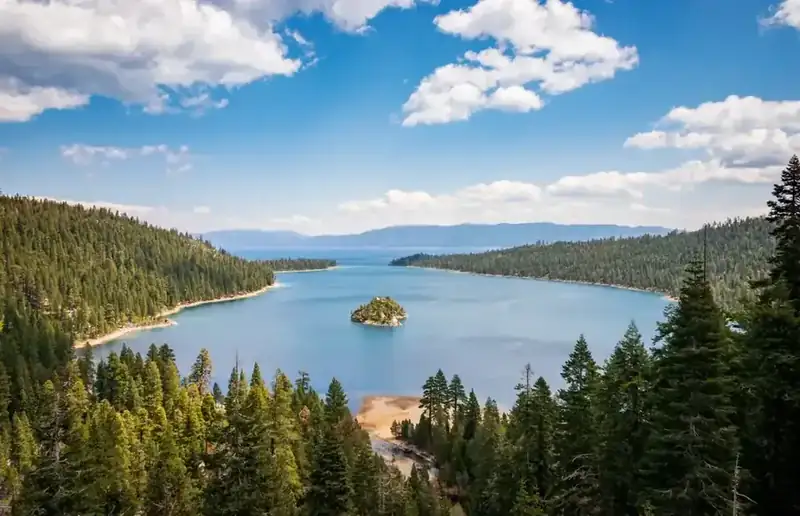
- Distinct National Park attempts
- at least 6 (1899; three in 1912–19; 1930; 1935) plus the 1883 state-park precursor
Sources
- Douglas H. Strong, Tahoe: From Timber Barons to Ecologists (1984
- Bison Books 1999) — the definitive account of every attempt
- Donald Pisani's Tahoe/Sierra land-policy scholarship
- San Francisco Examiner 1899 coverage
- Stewart papers
- 1883
California State Assembly resolution and a governor-appointed forestry commission propose a land swap with the Central Pacific for the railroad's California-side lands, "for the purpose of California holding and preserving it as a state park or state forest"; dies in the state senate. (Strong via SFGate; Tahoe Weekly)
- 1897–99
John Muir and the Sierra Club press for a giant Sierra forest reserve; federal agent B.F. Allen's proposal for nearly the whole California side is halved; April 13, 1899 — McKinley creates the 136,000-acre Lake Tahoe Forest Reserve (nucleus of Desolation Wilderness).
- 1899
STEWART'S NATIONAL PARK BILL. Sen. William M. Stewart (R-NV) proposes a Lake Tahoe National Park covering the whole basin and lands down the western slope, with a lieu-land swap for inholders — and a dam at Tahoe City to store surplus water for Nevada irrigation and Reno hydropower. The Examiner found "the bill rewarded the lumber companies that had already pillaged the Tahoe basin"; Muir opposed the deal; the bill died. (SFGate, citing Strong; Tahoe Weekly)
- 1912–1919
"Three efforts were made during that decade to have the lake declared a National Park, but all failed." (Encyclopedia.com, citing Strong) The Tahoe Fund dates one to 1913. Sponsors/bill numbers: VERIFY.
- 1930 and 1935
Further citizen attempts "to convince Congress to create a Lake Tahoe National Park" fail, "mainly due to the amount of development and private interests." (Tahoe Fund)
- 1958
Lake Tahoe Area Council; 1965 League to Save Lake Tahoe; 1969 Tahoe Regional Planning Compact (bi-state); 1969 Desolation Wilderness; 1973 Lake Tahoe Basin Management Unit (USFS); 1980 Santini–Burton Act (federal purchase of environmentally sensitive Tahoe lands); state parks from the 1920s–60s.