- Location
- California
- Current protection
- Garrapata, Andrew Molera, Pfeiffer Big Sur
- Status
- No active campaign
- In the book
- Featured in Undiscovered America
Why should it be a National Park?
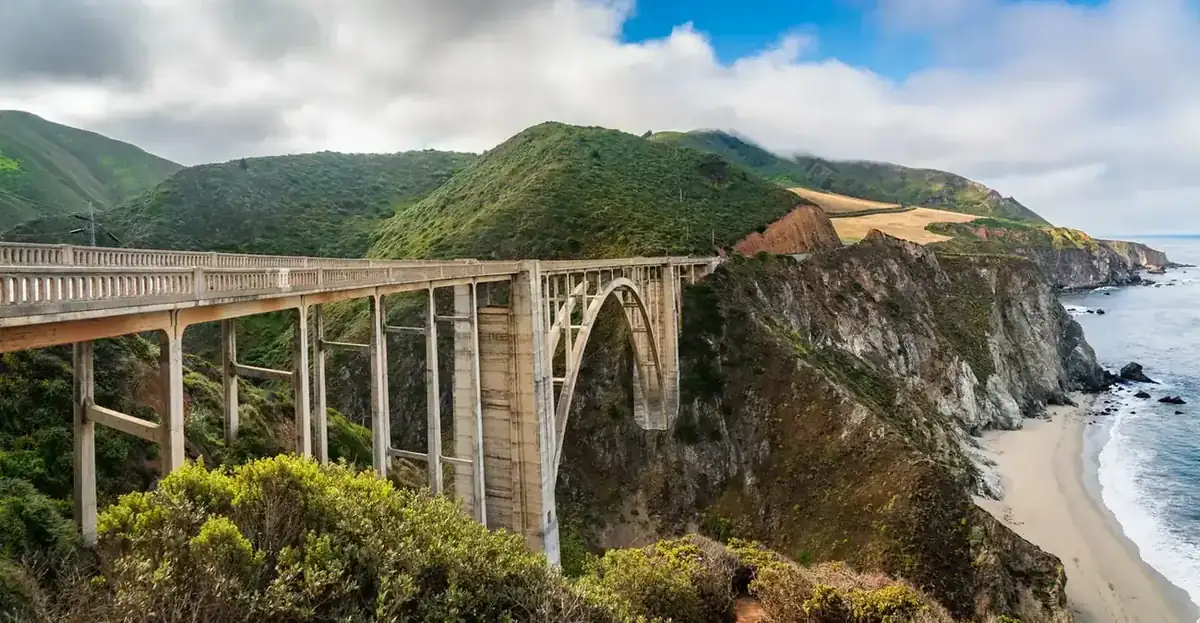
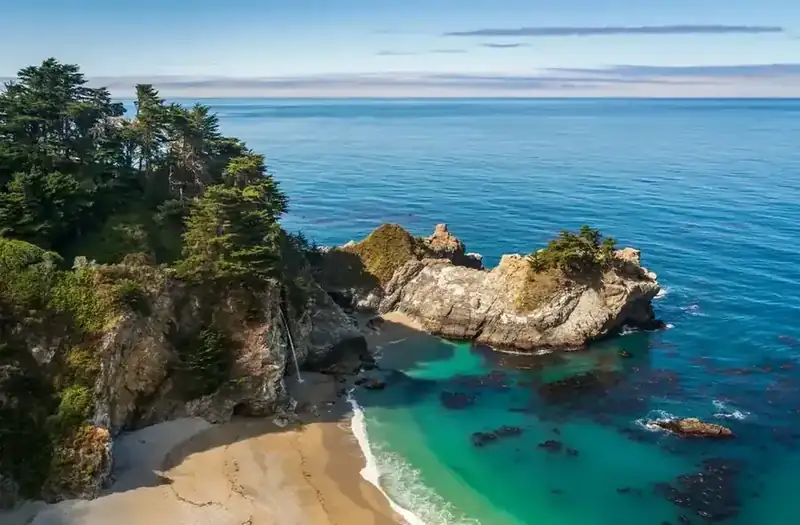
The exact geographic boundaries of Big Sur are debated. It is generally agreed upon that Big Sur is a rugged and mountainous section of California's Central Coast that lies somewhere between Carmel-by-the-Sea and Morro Bay, where the Santa Lucia Mountains rise abruptly from the Pacific Ocean. Highway 1 is the only route along the coast and gets congested during weekends and holidays, but the cliff-side curves and viewpoints are worth fighting the traffic.
Large sections of the natural environment carry various protections from federal, state, local, and private reserves and parks. This mashup of agencies, policies, and land managers leads to confusion with visitors. Some areas require fees to enter while others are free or illegal to enter.
State parks are the most visited sites in Big Sur, in addition to the Bixby Canyon Bridge. Popular state parks include Garrapata, Andrew Molina, Pfeiffer Big Sur, Julia Pfeiffer Burns, and Limekiln. These parks highlight aspects of the coastal landscape ranging from towering mountains, lush redwood forests, ocean cliffs, waterfalls, streams, and ample plant and animal life.
For more adventurous travelers, Las Padres National Forest extends from areas of the coast, up and over the mountains to the chaparral environment found inland. The interior of the mountains is made up of high peaks, deep canyons, thick forests, and enormous rock formations. One of the most interesting, but largely unknown, locations is a series of massive boulders and Native American archaeological sites known by the locals as 'The Indians'.
The Pacific Ocean coastline is badly in need of a National Park. In California areas like Big Sur, Lost Coast, and Sonoma Coast would make great candidates. Likewise, Oregon has no shortage of spectacular coastal cliffs, capes, sand dunes, and state parks that could become a spectacular park.
As populations rise in the coastal areas, these pristine environments are becoming flooded with people and the development projects that follow them. Any of the regions listed above could be set aside to protect the coast before it becomes a memory that can only be revisited through calendars and old car commercials.
It could be argued that Olympic, Redwood, and Channel Islands National Parks protect small sections along the coast, but each of them protects a unique and specific aspect of the coastal environment. None of them protect anything on this scale or grandeur of the Big Sur coast and ignoring such an impressive natural feature of the American landscape is an oversight for the National Parks.
Big Sur has been considered for redesignation as a National Park Service area on several occasions. Proposals were made in 1977, 1980, and 1985.
The history of National Park Campaigns
Big Sur's federalization fight (1977–1986) is one of the best-known cases of local defeat of a national protective designation. An Ansel Adams–led group sought a National Park (1977); after roughly 98% local opposition surfaced, the effort morphed into a Big Sur National Scenic Area (Forest Service–administered, ~700,000 acres, ~$100M). Sen. Alan Cranston and Rep. Leon Panetta carried bills; Sen. S.I. Hayakawa and Big Sur residents killed them. The lasting outcome was local control via the Big Sur Local Coastal Program (1986), plus wilderness (Ventana 1969, Silver Peak 1992) and the Monterey Bay National Marine Sanctuary (1992).
- Distinct National Park attempts
- 1 (1977 Adams-led park idea).
- National scenic area / federal designation attempts
- ~4 (Cranston Jan. 1980 amendment; Cranston S. 2551, April 1980; Panetta June 1980 House bill; S. 2159, 1985–86). Other designations achieved: Ventana Wilderness 1969, Silver Peak Wilderness 1992, Monterey Bay NMS 1992, wild & scenic river 1992
Sources
- Lorentzen & Nichols, Hiking the California Coastal Trail (and the californiacoastaltrail.org history essay)
- Robert Turnage, "Ansel Adams: The Role of the Artist in the Environmental Movement," The Living Wilderness (1980)
- 1986 Congressional Record Index (govinfo, CRI-1986)
- congress.gov S. 2551 (96th) and S. 2159 (99th)
- Big Sur Gazette archives
- bigsurlcp.com
- 1969
Ventana Wilderness designated (Los Padres NF).
- Autumn 1977
Ansel Adams–led National Park push (NP attempt #1). Per California Coastal Trail, "How Big Sur Almost Became a National Park and Why It Didn't": "In autumn 1977 Gary Koeppel, a Big Sur gallery owner, learned that some affluent Monterey Peninsula residents led by Ansel Adams wanted to make Big Sur a National Park... An informal poll found 98% of Big Sur people opposed the park idea." Koeppel launched the Big Sur Gazette (1978) to organize opposition.
- Spring 1978
Big Sur Foundation formed by park proponents.
- Nov. 1979
Adams presents President Carter a confidential memo on preserving Big Sur.
- Jan. 1980
Cranston omnibus-parks amendment to let Los Padres NF expand by any amount of land; withdrawn after ~2,000 telegrams/calls and Hayakawa's counter-lobbying of Big Sur residents.
- Feb.–April 1980
Wilderness Society "national scenic area" plan announced (to be USDA/Forest Service–administered rather than Interior/NPS). [Round 7: CONFIRMED — Sen. Alan Cranston introduced S. 2551, the "Big Sur Coast National Scenic Area Act," on April 3, 1980 (96th Cong.); referred to Senate Energy and Natural Resources; hearings held before the Subcommittee on Parks, Recreation and Renewable Resources; no further action; died.]
- June 1980
Rep. Leon Panetta (D-CA) House bill, Big Sur National Scenic Area (96th Cong.). Per Wikipedia (Leon Panetta), the bill "would have created a 700,000-acre... scenic area administered by the U.S. Forest Service," and "budgeted $100 million to buy land from private land owners, up to $30 million for easements and management programs, and created a state plan for a zone about 75 miles long and 5 miles wide along the Big Sur coast." Pushed by Rep. Phillip Burton, it passed the House by roughly a two-thirds majority but died in the Senate under a Hayakawa "hold." [Round 7: exact H.R. number still NOT FOUND.] Sources: Wikipedia "Leon Panetta"; californiacoastaltrail.org.
- 1985–1986
S. 2159 (99th Cong.), "Big Sur National Forest Scenic Area." Confirmed in the 1986 Congressional Record Index under "Landscape Protection... Big Sur National Forest Scenic Area, CA: designate (see S. 2159)," and corroborated by the Dale Bumpers Papers finding aid ("Big Sur National Forest Service Area Act (S. 2159) Materials, 1985-1986"). Referred to committee (Senate Energy & Natural Resources); no floor action recorded; died. Sources: govinfo CRI-1986; University of Arkansas finding aid.
- 1986
Big Sur Local Coastal Program adopted by Monterey County — the local-control alternative that ended federalization. Source: bigsurlcp.com.
- 1992
Silver Peak Wilderness and Monterey Bay National Marine Sanctuary established; the Los Padres Condor Range and River Protection Act of 1992 designated Big Sur River wild & scenic segments (its precursor, Rep. Robert Lagomarsino's H.R. 1473 in the 101st Congress, passed the House with amendments in October 1989 but never got a Senate floor vote).