- Location
- Utah/Arizona
- Current protection
- Glen Canyon National Recreation Area, Vermilion Cliffs National Monument, Honeymoon Trail
- Status
- Active citizen campaign
- In the book
- Featured in Undiscovered America
Why should it be a National Park?
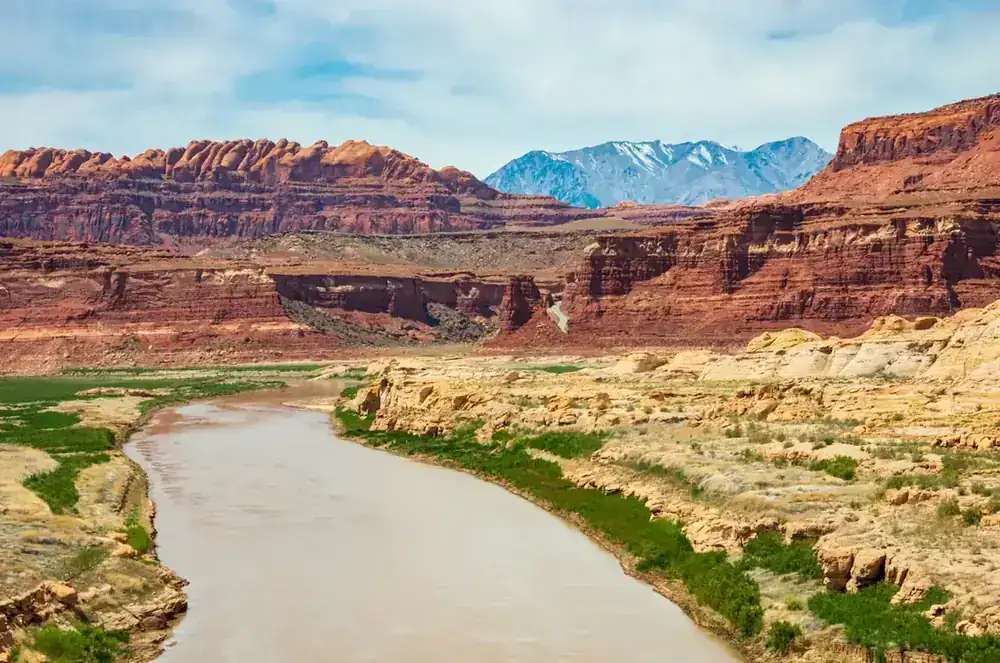
Glen Canyon is a magnificent series of several canyons in southern Utah containing hundreds of archaeological sites, picturesque sandstone formations and gorges. Despite the right natural and cultural history to make this area worth conservation, it was severely altered in the mid-1960s with the creation of the Glen Canyon Dam.
As Americans spread westward, the lack of water became an obvious problem. The solution the government came up with was to dam the mighty Colorado River and create reservoirs to fuel this influx of people. Today, there are 15 dams on the main stem of the river, with hundreds more on its tributaries. The dam solution worked at first, but in recent years the shortsightedness of the plan has become apparent.
The two main and notable dams are the Hoover and the aforementioned Glen Canyon, which when built resulted in the creation of Lake Mead and Lake Powell, respectively. However, many may not be aware that in the last two decades the water levels of each lake have fallen to 30 percent capacity and continue to drop. This water shortage is a worsening problem, and scientists have no reason to believe this trend will change.
Before the Glen Canyon Dam was constructed, there were calls to protect this region for its geological and historical value. The receding waters give us the opportunity to protect the canyon once again.
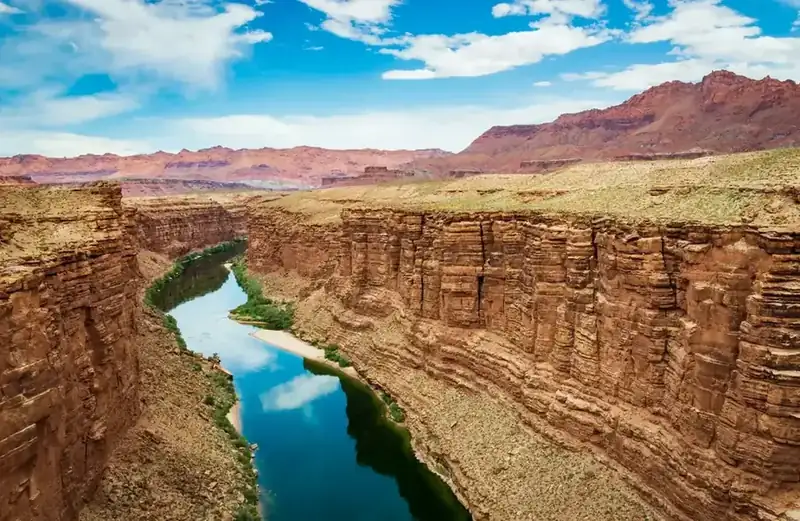
Glen Canyon provides an incredible geologic timetable in its red rock cliff faces, which also exhibit ruins and artwork from Native American Indian civilizations from the first century A.D. through the present. Luckily, Lake Powell did not wash away all of these ancient artifacts and the natural beauty of the area is largely intact.
Restoration organizations are fighting for the removal of the Glen Canyon Dam and to establish the Glen Canyon National Park. The remaining water would be sent downriver, raising water levels in the waning Lake Mead. Currently, the water is evaporating faster than it's being replenished by the Colorado River. By removing the dam, the remaining waters can replenish Lake Mead, restoring Glen Canyon's impressive gorges, rock formations, and endangered historical artifacts; some of which are currently underwater.
The Glen Canyon Institute is a non-profit organization dedicated to the restoration of Glen Canyon and a free flowing Colorado River.
The history of National Park Campaigns
Glen Canyon was inside the largest park proposal in American history — Harold Ickes's Escalante National Monument (1936–40) — which Utah killed, leaving the canyon unprotected when the Bureau of Reclamation came for it in the 1950s. The Park Service circulated a "Grandview National Park" idea internally in 1944; the dam (1956–63) and Glen Canyon NRA (1972) followed. Since 1995–96 the Glen Canyon Institute has campaigned to drain Lake Powell and restore Glen Canyon, drawing a hostile 1997 congressional hearing and annual Utah appropriations riders.
- Distinct National Park attempts
- 1–2 (1944 "Grandview National Park," internal; the Escalante proposals were for a monument/recreation area)
- Other designation attempts
- monument 1936, 1938; recreation area 1940; NRA 1972; the GCI restoration campaign (1996–present)
Sources
- Elmo Richardson, "Federal Park Policy in Utah: The Escalante National Monument Controversy of 1935–1940," Utah Historical Quarterly 33 (1965)
- Samuel Schmieding, From Controversy to Compromise to Cooperation: The Administrative History of Canyonlands National Park (NPS, 2008)
- Utah State Archives, "A Monumental Controversy in Utah" (2024), with the 1936 and 1938 maps (Series 22028
- Series 186)
- House Resources Subcommittee on National Parks and Public Lands, Lake Powell hearing (Sept. 1997)
- Scott K. Miller, "Undamming Glen Canyon," Stanford Environmental Law Journal 19 (2000)
- Jared Farmer, Glen Canyon Dammed (1999)
- 1910
Rainbow Bridge National Monument.
- 1935
NPS survey of southern Utah (regional director M.R. Tillotson; a proposed 6,980-square-mile withdrawal from the Green–Colorado confluence to the Waterpocket Fold). (Schmieding, Canyonlands Administrative History; National Park History substack)
- 1936
ESCALANTE NATIONAL MONUMENT proposed by Interior Secretary Harold Ickes: 6,000+ sq mi (~4.5 million acres) including Glen Canyon; The Wilderness Society the same year identifies the 8.8-million-acre "Colorado River Canyons" as the largest roadless tract in the lower 48. The NPS opens a 1936 Utah meeting by asserting ranching is a dying industry — a blunder that hardens opposition; Gov. Henry Blood mobilizes Utah's senators over water rights. (Utah State Archives; Schmieding)
- 1937
Capitol Reef NM proclaimed as a partial fulfillment.
- 1938
Second, "skinny" Escalante proposal: 2,450 sq mi along the Colorado; "severely criticized." (Utah State Archives)
- 1940
Repackaged as an Escalante National Recreation Area by congressional bill; "never made it out of congressional committee." (Utah State Archives)
- 1942–43
Escalante surveys continue; 1944 — "Grandview National Park" proposal circulated internally at NPS regional and Washington offices (map in Schmieding). (Schmieding, Canyonlands adhi, timeline)
- 1946–56
Bureau of Reclamation's CRSP; Glen Canyon Dam chosen over Echo Park; April 11, 1956 CRSP Act; October 1, 1956 construction begins; 1963 dam complete; Sierra Club's The Place No One Knew (1963).
- 1960–64
Leo Diederich's regional-park concept → Canyonlands National Park (1964) for the upstream country. (Schmieding)
- October 27, 1972
Glen Canyon National Recreation Area (P.L. 92-593); 1980 — Lake Powell first fills.
- 1995–96
Dr. Richard Ingebretsen founds the Glen Canyon Institute (Salt Lake City); 1995 Brower–Dominy debate; November 1996 — Sierra Club board votes overwhelmingly to support draining Lake Powell; GCI commissions a $350,000 Citizens' Environmental Assessment (David Wegner). (High Country News, 1997; Earth Island Journal)
- September 23–24, 1997
Rep. James V. Hansen (R-UT) convenes House Resources subcommittee hearings on draining Lake Powell; the idea is called "loony," "impractical," and "certifiably nutty"; Rep. Chris Cannon introduces a resolution denouncing it; Utah delegation begins attaching annual riders barring federal study of draining (e.g., 2005). (Stanford Environmental Law Journal 19:1 (2000); Canyon Country Zephyr; County Highway)
- 2022–2025
Lake Powell falls toward dead pool; Cathedral in the Desert reemerges; GCI reframes as "restoration in progress" and researches legal strategies to protect the reemerging canyon. (Earth Island Journal)